Airbus, Airline Partners Advance Wake Energy Retrieval


.webp)
.webp)
.webp)
.webp)
TOULOUSE — Airbus, alongside partners Air France (AF), Delta Air Lines (DL), French bee (BF), Virgin Atlantic (VS), and key European and North Atlantic air-navigation service providers, has completed a major phase of flight trials for its fello’fly initiative, a project aiming to reduce long-haul fuel burn by pairing aircraft to harvest wake-generated lift.
The trials, conducted under the SESAR Joint Undertaking’s GEESE programme, involved eight coordinated flights over the North Atlantic between September and October 2025. Although the flights did not perform wake-energy retrieval itself, they successfully validated the most complex prerequisite: the ability for two aircraft from different airlines to execute a precisely timed and safely regulated rendezvous procedure within oceanic airspace.
Geese-Inspired Efficiency
Fello’fly draws from a familiar natural example: migratory birds. By flying in formation, trailing birds benefit from aerodynamic uplift generated by the leader—reducing energy expenditure. Airbus calculates that applying this principle to commercial aviation could cut long-haul fuel burn by up to 5% per paired aircraft, representing substantial emissions reductions across global fleets.
Achieving this, however, requires unprecedented cross-industry synchronization to ensure safety, regulatory compliance, and air-traffic predictability—especially in the vertically constrained but heavily trafficked North Atlantic.
Rendezvous Validated
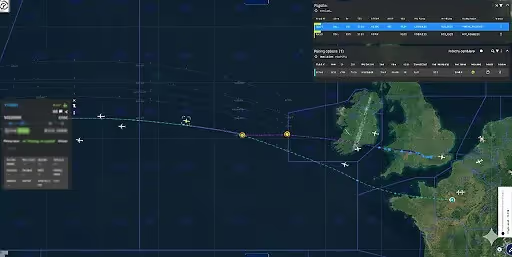
The 2025 trial phase tested the most operationally demanding element: guiding two aircraft, operating normal commercial flights, to meet at exactly the same waypoint at the same time under full ATC supervision.
Airbus confirmed that the four-step rendezvous sequence worked as designed:
- Real-Time Pairing & Trajectory Calculation
Airbus’ Pairing Assistance Tool (PAT) generated optimized trajectories and shared them simultaneously with both flight crews, airline operations control, and ATC. - Operational Approval Loop
Dispatchers, crews, and ATC centers—using the EUROCONTROL Innovation Hub interface—evaluated trajectory changes collaboratively, ensuring full situational awareness. - En-Route Adjustment
One aircraft adjusted its routing to converge with the partner flight. - Commit to Meet
Both crews activated a cockpit function to ensure arrival at the rendezvous point at a precise, predetermined moment.
The synchronization required involvement from AirNav Ireland, DSNA (France), EUROCONTROL, NATS, and U.S. and European flight operations teams, demonstrating feasibility in real-world, multi-jurisdiction operations.
Building Toward Wake Energy Retrieval Flights
While these tests stopped short of placing a trailing aircraft in the leader’s uplift zone, they clear a critical milestone. Airbus says controlled, certified, wake-energy retrieval on commercial flights will follow once safety cases, regulatory frameworks, and onboard systems are validated.
A Collaborative Model for Future Air Traffic Management
Launched in 2019, fello’fly has evolved into one of Europe’s most technically ambitious environmental aviation projects. The broader GEESE project brings together a long list of partners—including Indra, ENAC, Boeing, CIRA, Frequentis, UCLouvain, DLR, and others—reflecting the scale of coordination required.
Airbus describes the initiative as “biomimicry meets digital air-traffic modernization,” combining aerodynamic insight with real-time connectivity tools and next-generation trajectory-based operations.
Aviation Insight: What This Means for the Industry
Fello’fly’s progress hints at a future in which airlines could regularly pair aircraft on long-haul routes to reduce emissions—an efficiency concept that does not require new engines or airframes.
Key implications include:
- Operational Collaboration Becomes Normalized
Airlines may eventually coordinate schedules to allow pairing, shifting competitive logic on trunk routes. - ATC Modernization Accelerates
Wake-energy retrieval requires trajectory-based operations, dynamic rerouting, and real-time inter-center coordination—pushing ANSPs toward the next generation of digital ATM. - Fleet Efficiency Gains Without Hardware Upgrades
A 5% fuel burn reduction rivals the performance gains of some next-gen engine programs. - Sustainability Targets Align With Airspace Innovation
This approach complements SAF and new-tech aircraft by improving efficiency of the existing fleet.
The next major milestone will be live wake-energy retrieval trials, which Airbus describes as “the final step before operationalization.”
Featured image: Dee Onederer/Pexels



.avif)