



.webp)
.webp)

.webp)

DALLAS — Today, General Electric is best known for its jet engines, but that wasn’t always the case. The company began far from aviation, rooted instead in electricity, power generation, and everyday industrial needs.
General Electric was founded in 1892, during the early days of electrification in the United States. Closely linked to Thomas Edison, the company initially focused on electrical equipment, power systems, and heavy industrial machinery, long before aviation became part of its business.
GE Aerospace as a standalone public company was officially created on April 2, 2024, following the spin-off from the original General Electric (GE), though its roots as GE's aviation division go back to the 1940s and a formal "GE Aerospace" name was used for a division in the 1960s.
GE’s First Steps Into Aviation
GE’s path into aviation did not begin with jet engines. Instead, it started much earlier, with a far less glamorous but critically important technology: turbo-superchargers. In the early days of military aviation, aircraft relied entirely on piston engines, which faced a severe limitation. As planes climbed higher, the air became thinner, oxygen levels dropped, and engine power fell sharply. This made high-altitude flight difficult, slow, and often unreliable.
To solve this problem, the U.S. government turned to General Electric during World War I. GE engineers demonstrated a 350-horsepower turbo-supercharged Liberty aircraft engine, proving that forced induction could restore lost power at altitude.
From a modern perspective, this naturally raises a question: why was an electrical and appliance manufacturer developing advanced components for military aircraft engines? The answer lies in what GE already was. Appliances were only a small and visible part of the company’s business. By the early 20th century, General Electric had evolved into a heavy industrial engineering powerhouse, with deep expertise in steam turbines, high-temperature metallurgy, precision machining, and large-scale manufacturing.
America's First Jet Engine
By 1942, with the Second World War at its height, the United States Army Air Forces tasked General Electric with building an American version of the British Whittle W.1X turbojet engine.
The project marked the United States’ first serious step into jet propulsion. The engine was built at the company’s facility in Massachusetts. The result was the I-A engine, America’s first operational jet engine, which laid the foundation for the country’s future jet engine industry.
In the late 1940s, GE introduced the J-47 gas turbine engine, which became the most-produced jet engine of the early jet age, powering aircraft such as the F-86 Sabre and several other new fighters. The success of J-47 transformed GE almost overnight, driving rapid production growth, new factories, and a significant expansion of its workforce.

GE Enters the Commercial Jet Engine Market
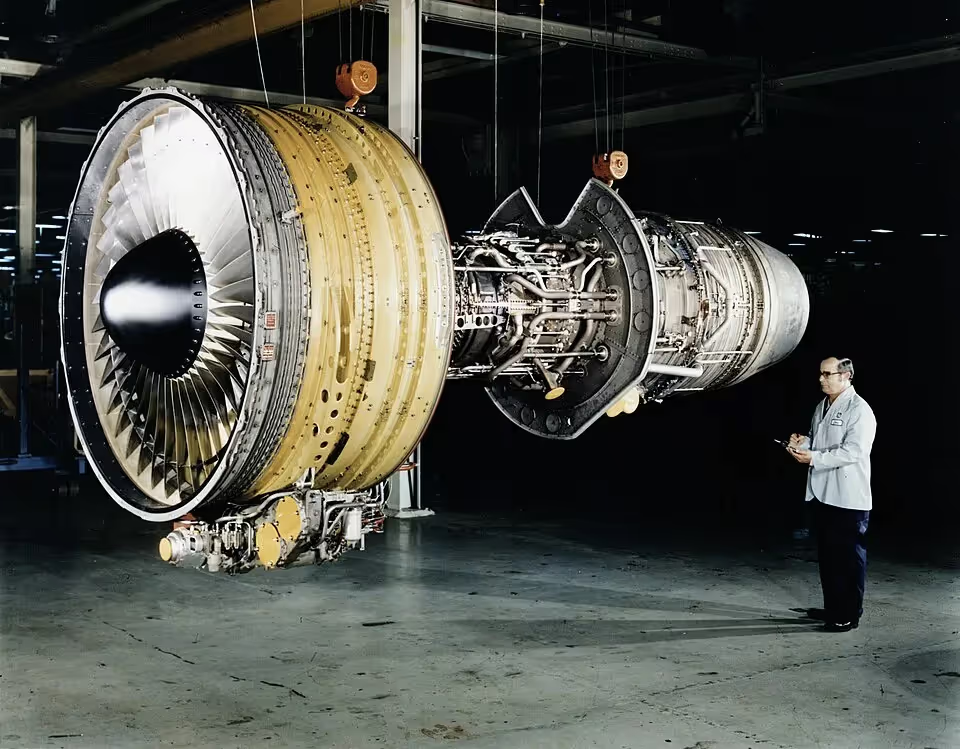
In the mid-1960s, GE began work on the CF6, which entered commercial service in 1971, powering the DC-10 trijet. The engine proved to be a major success and was later selected for a wide range of commercial aircraft, including the Boeing 747, Airbus A300, A310, A330, Boeing 767, and the MD-11.
The success of the CF6 firmly established GE as a major player in the commercial jet engine market, putting the company in direct competition with long-established manufacturers such as Pratt & Whitney and Rolls-Royce.
GE-Saffran Joint Venture
In 1971, the French company Safran, then known as Snecma, began working with General Electric on a new commercial jet engine. The partnership was formalized in 1974 with the creation of a 50–50 joint venture called CFM International.
Under the arrangement, Safran was responsible for the fan and low-pressure systems, while GE provided the engine core. This collaboration led to the development of the CFM56 turbofan.
In 1981, the CFM56 was chosen to power the Boeing 737 Classic. Later in the decade, Airbus also selected the engine for the A320 family, placing the CFM56 on two of the most widely used narrowbody aircraft programs in commercial aviation.
The success of the CFM56 did not end with the aircraft it powered in the 1980s and 1990s. Despite being introduced decades ago, the engine remains in service today, powering numerous commercial aircraft worldwide.
CFM International later introduced an updated engine family known as the LEAP series. The LEAP now powers newer aircraft such as the Airbus A320neo and the Boeing 737 MAX. With thousands of these aircraft still awaiting delivery, the LEAP remains in full-scale production and is expected to remain a central part of commercial aviation for years to come.

The GE90
In the early 1990s, General Electric began developing the GE90 to power Boeing’s new widebody aircraft, the Boeing 777. The 777 was designed around the idea that a twin-engine plane could safely operate long-haul routes following the relaxation of ETOPS rules, which required engines that were both highly powerful and extremely reliable.
For the earliest versions of the 777, however, the GE90 proved to be more engine than necessary. At the time, it was the largest and most powerful commercial jet engine in the world, making it excessive for standard variants such as the 777-200 and 777-300. As a result, these early aircraft were also offered with engines from Pratt & Whitney and Rolls-Royce.
That changed when Boeing introduced the longer-range variants of the aircraft. With the launch of the 777-200ER, 777-200LR, and 777-300ER, the GE90’s power became a clear advantage. The 777-200LR and the 777-300ER were powered exclusively by the GE90-115B, which remains the most powerful commercial jet engine ever to enter service.

The success of the GE90 didn’t end with the original 777. In 2013, Boeing launched the 777X program, the upgraded version of the Boeing 777. The new aircraft will be powered exclusively by the GE9X, a next-generation engine developed by General Electric as the successor to the GE90.
Summary
From its early work on steam turbines to turbo-superchargers, jet engines, and modern high-bypass turbofans, General Electric’s path into aviation was built on industrial capability rather than chance. What began as electrical and mechanical engineering expertise gradually evolved into one of the most influential jet engine portfolios in commercial and military aviation.
Featured image: GE Aerospace





.avif)

