

.webp)
.webp)
DALLAS — On September 7, 2008, Palma de Mallorca-based Futura International Airways (FH) halted operations amid financial difficulties. The Spanish charter airline initially sought a way to restart, but the suspension left its workforce of about 1,200 facing an uncertain future.
Futura had carried 3.7 million passengers in 2007. On September 8, it sought protection from creditors in a Spanish commercial court, according to RTÉ. The airline blamed its financial position in part on rising oil prices.
The loss of aircraft soon complicated the rescue effort. On September 9, RTVE reported that GE Commercial Aviation Services (GECAS) had withdrawn 15 of Futura’s 32 aircraft, citing airline president Román Pané. Workers’ representatives were seeking assurances that staff would receive their wages at the end of the month.
The regulatory decision followed later. EFE reported on September 22 that Spain’s Directorate General of Civil Aviation had suspended Futura’s operating license after the airline failed to secure an investor for its business plan. The suspension was temporary: the license could be reactivated if an investor emerged before January 1, 2009, and the carrier demonstrated that it met the required conditions.
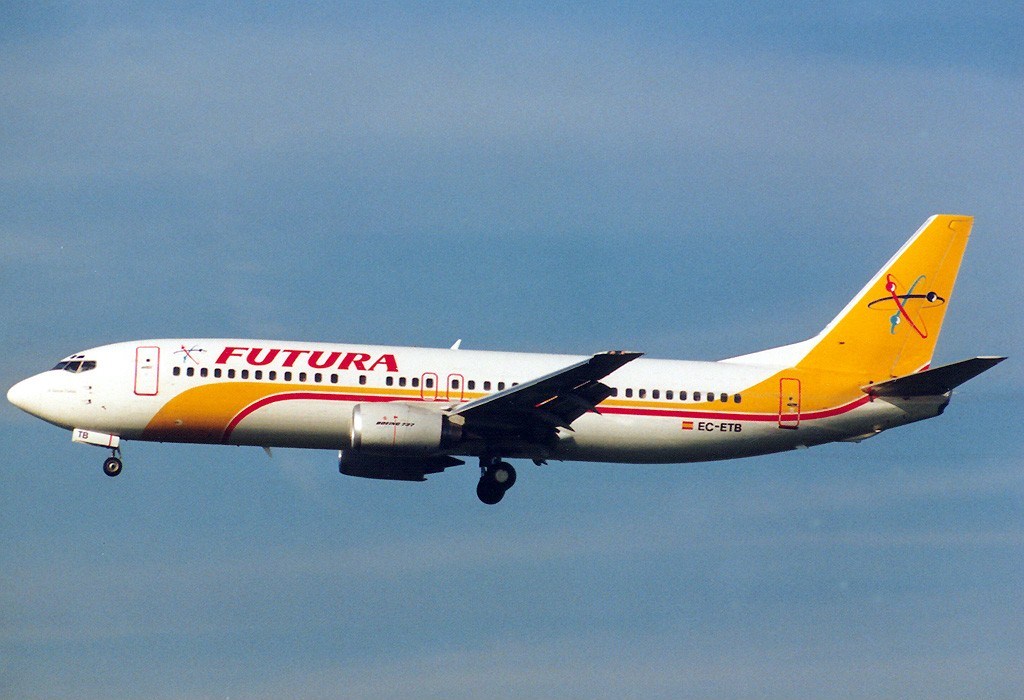
Formation and ownership
Futura was established in 1989 with Aer Lingus (EI) backing. Originally known as CHIASA, it was renamed before starting operations on February 17, 1990. Its business included charter flights for tour operators and other airlines, scheduled services, and wet leases.
Aer Lingus sold its majority holding in 2002. Its remaining 20% stake was sold in October 2007, ending the Irish airline’s investment in Futura. The transaction formed part of the purchase of Futura by Hutton Collins and the airline’s management, as The Irish Times reported at the time.
Expansion before the shutdown
Futura also moved into cargo. In May 2006, Europa Press reported on plans for its Flyant venture to use a Boeing 737-300F on services linking mainland Spain and the Canary Islands. The initial schedule called for five flights a week, with a second aircraft planned later that year.

Its Irish subsidiary, Futura Gael, also suspended trading in September 2008 while seeking fresh investment. RTÉ reported that Irish tour operators were arranging replacement aircraft for customers booked on its flights.
Only months earlier, Futura had been adding a larger member of the Boeing 737 family. On May 6, 2008, CFM International marked delivery of the airline’s first 737-900ER, powered by CFM56-7B engines. By September, the focus had shifted from fleet expansion to finding the funding needed to resume flying.
Historical photo: Futura International Airways Boeing 737-400 EC-IOU at Bournemouth on August 7, 2004. Photo: Les Rickman/GFDL 1.2.



.avif)

