

.webp)
.webp)
.webp)
.webp)
HONG KONG — Cathay Pacific Airways (CX) posted its strongest first-half profit since 2010 as passenger and cargo demand, an improved performance at HK Express, and a one-off gain connected to Air China lifted the group result.
The Cathay Group reported a profit attributable to shareholders of approximately HK$6.2 billion (US$795 million) for the six months ended June 30, 2026, up about 71% from HK$3.65 billion a year earlier. Group revenue increased 25.3% to approximately HK$68 billion.
The historical comparison is significant but requires qualification. Cathay earned HK$6.84 billion in the first half of 2010, meaning the 2026 result is the best since that period rather than a new first-half record.
One-Off Gain Boosts the Headline Increase
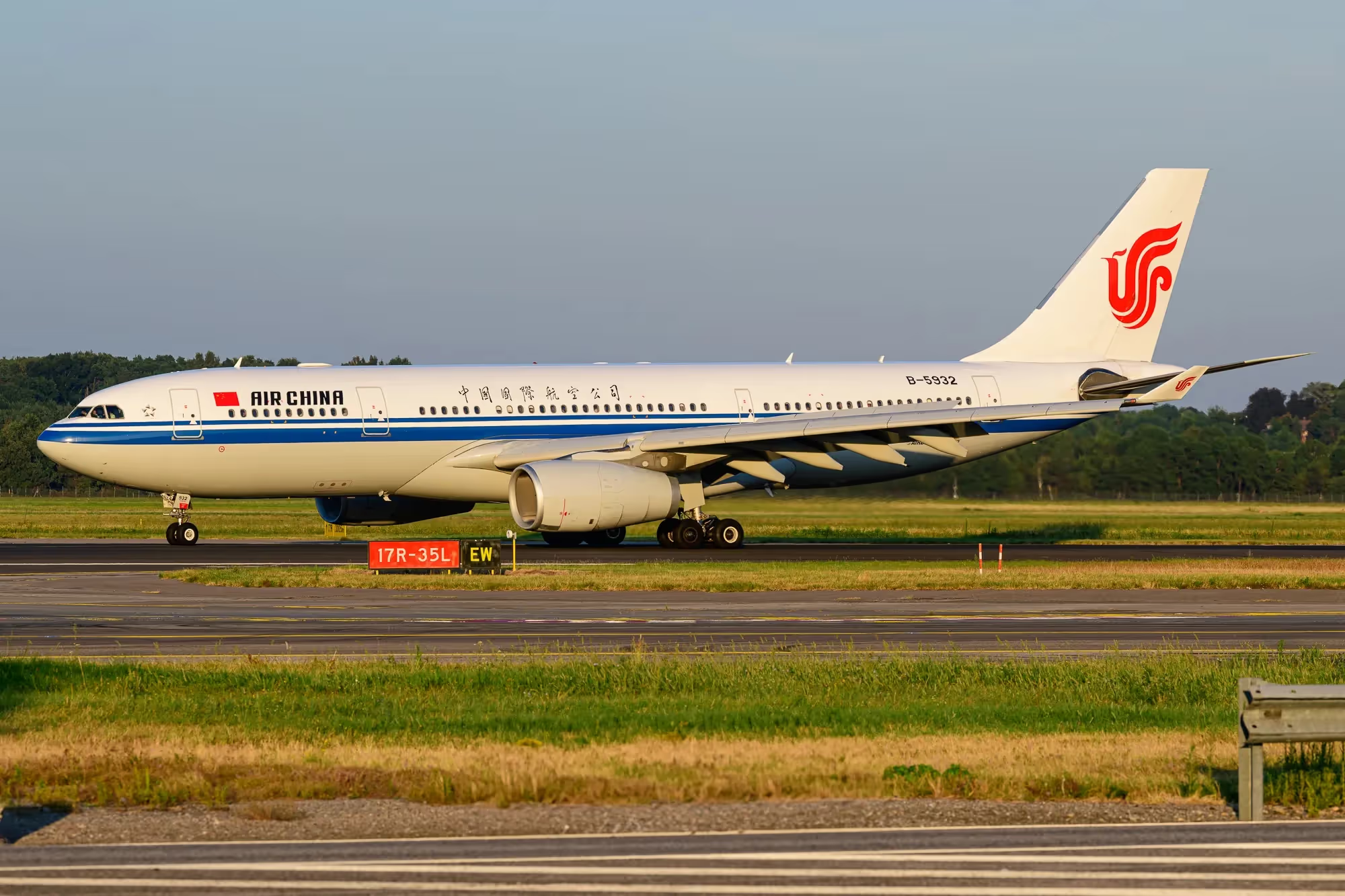
Approximately HK$1.4 billion of the 2026 profit came from a deemed partial disposal gain after Cathay's ownership interest in Air China (CA) was diluted by the mainland carrier's issuance of new shares.
Cathay disclosed the expected gain in its May traffic update. A deemed disposal is an accounting event: Cathay did not need to sell shares for its percentage interest to decline. Air China's enlarged share count reduced Cathay's proportional ownership, requiring the group to recognize the change in the value of its interest.
That gain accounts for more than one-fifth of Cathay's reported first-half profit. Excluding it as a simple illustration—not as a company-defined adjusted result—leaves about HK$4.8 billion. That remains above the prior-year attributable profit, but it shows that the underlying improvement was much smaller than the 71% headline increase.
The distinction matters because investors and aviation readers use operating performance to assess whether an airline can sustain earnings. Passenger revenue, cargo returns, unit costs, fuel exposure, and associate contributions can recur; a gain caused by dilution of an equity stake cannot be assumed to repeat.
More Passengers Moved Through Hong Kong
Cathay Pacific carried 17.5% more passengers during the first half than in the same period of 2025, while low-cost subsidiary HK Express (UO) carried 9.8% more. Passenger revenue at the full-service airline increased 26.3% to approximately HK$43.2 billion.
The volume growth is important for Cathay's Hong Kong International Airport (HKG) hub. More connecting passengers allow the airline to support a broader network than local demand alone could sustain, strengthening Hong Kong's role as a transfer point between Asia and long-haul markets.
Cathay said in its July first-half performance update that demand remained solid at Cathay Pacific and Cathay Cargo, HK Express improved, and associates made stronger contributions. The company also said connecting traffic through Hong Kong benefited when travelers shifted away from other hubs during Middle East disruption.
Traffic growth alone does not establish stronger pricing power. In 2025, Cathay Pacific increased first-half passenger capacity by 26.3%, but passenger yield fell 12.3% as supply returned to the market. The 2026 filing's yield and unit-revenue figures are therefore essential to determine how much of the latest revenue growth came from fuller aircraft, higher capacity, or fares.
Cargo and HK Express Add Diversification
Cathay's business mix gives it more than one source of airline revenue. Belly space on passenger aircraft and dedicated freighters support Cathay Cargo, while HK Express serves the price-sensitive regional market with a low-cost model.
Cargo provides useful diversification when passenger markets or particular regions weaken, but its economics depend on both volume and yield. In the first half of 2025, Cathay Cargo carried 11.4% more tonnage while yield fell 3.4%, demonstrating why higher shipment volume does not automatically translate into proportional profit growth.
HK Express had its own recovery task. Its rapid 2025 capacity expansion pushed first-half passenger yield down 21.6% and load factor down 6.1 percentage points. Cathay's statement that the subsidiary improved in 2026 suggests a better balance between capacity, pricing, and demand, but the divisional result and operating statistics are needed to measure the extent of that recovery.
Fuel Remains the Second-Half Test
The first-half result arrived despite elevated jet-fuel prices associated with Middle East conflict. Fuel is generally one of an airline's largest variable expenses, and a long-haul network is particularly exposed because small changes in the price per unit are multiplied across large volumes.
Cathay can recover part of that pressure through passenger and cargo fuel surcharges, pricing, hedging, and operational efficiency, but each mechanism has limits. Surcharges can shift some cost to customers, while hedges may delay or reduce exposure rather than eliminate it.
The second half will show whether traffic and revenue can continue outpacing fuel and other operating costs after the one-off Air China gain drops out of the comparison. Cathay's capacity plans, passenger yields, cargo pricing, and HK Express margins will provide the clearest evidence of whether 2026's underlying improvement is durable.
Featured image: Christian Winter/Airways



.avif)