




DALLAS — Greenland is undertaking the most significant infrastructure modernization in its history through a coordinated three-airport development program: Nuuk International Airport (GOH) opening in November 2024, Ilulissat International Airport (JAV) and Qaqortoq Regional Airport (JJU), both expected to open this year.
The combined project represents an investment of approximately USD 800 million–1 billion, reshaping the autonomous territory's economic trajectory and geopolitical positioning in the Arctic.
This report examines the national policy framework, international financing architecture, timeline and cost evolution, operational implications for aviation networks, and the complex geopolitical interests—including Danish stewardship, EU/Nordic Investment Bank (NIB) involvement, blocked Chinese participation, and emerging US strategic focus—that have shaped Greenland's airport modernization agenda.
1. Background and Strategic Context
1.1 Greenland's Geographic and Economic Position
Greenland, an autonomous territory within the Kingdom of Denmark, covers 2.166 million square kilometers but maintains a population of approximately 57,000–58,000 residents concentrated in coastal settlements. The territory's economy is heavily dependent on public-sector employment, fisheries (particularly shrimp, fish, and halibut), and subsidies from Denmark.
Historically, Greenland's extreme remoteness has imposed significant barriers to access: no road infrastructure connects settlements, and air transport has been the primary lifeline.
The capital, Nuuk, contains roughly one-third of Greenland's population and serves as the de facto economic and administrative center. Prior to the airport modernization, Nuuk was accessible only via domestic helicopter hops from Kangerlussuaq, a US-built Cold War airfield located ~310 km inland, which forced all transatlantic traffic through either Iceland or Copenhagen.
1.2 The 2018 Airport Package: Strategic Pivot
In 2018, the Greenlandic government announced an ambitious "airport package"—formally called the Airport Infrastructure Program or AIP—to construct three modern, internationally compliant airports. This represented a fundamental strategic shift:
- Previous model: Kangerlussuaq as de facto hub; limited transatlantic capacity; high connectivity costs; domestic reliance on helicopters and smaller fixed-wing aircraft
- New model: Nuuk as primary international hub with 2,200-meter runway; Ilulissat as secondary international gateway; Qaqortoq as regional connector; direct transatlantic access
The program was embedded in Greenland's broader diversification strategy, targeting growth in mining (rare earths and other critical minerals), fresh seafood exports, tourism, and Arctic research. It was also a response to earlier Chinese overtures: in 2018, the state-owned China Communications Construction Company (CCCC) proposed financing and constructing modern airports in Greenland, an offer that raised concerns in Copenhagen and Washington about strategic dependence and military access.
2. National Policy and Governance Framework
2.1 Institutional Structure
Kalaallit Airports International A/S is the primary implementing entity, established as a joint venture with ownership split:
- Greenland Government: 66.67%
- Denmark Government: 33.33%
This ownership structure ensures both Greenlandic autonomy and Danish oversight, a compromise reflecting Greenland's sovereignty aspirations while acknowledging its membership in the Kingdom of Denmark. Operationally, Greenland Airports (part of the Kalaallit structure) serves as the operator and administrator.
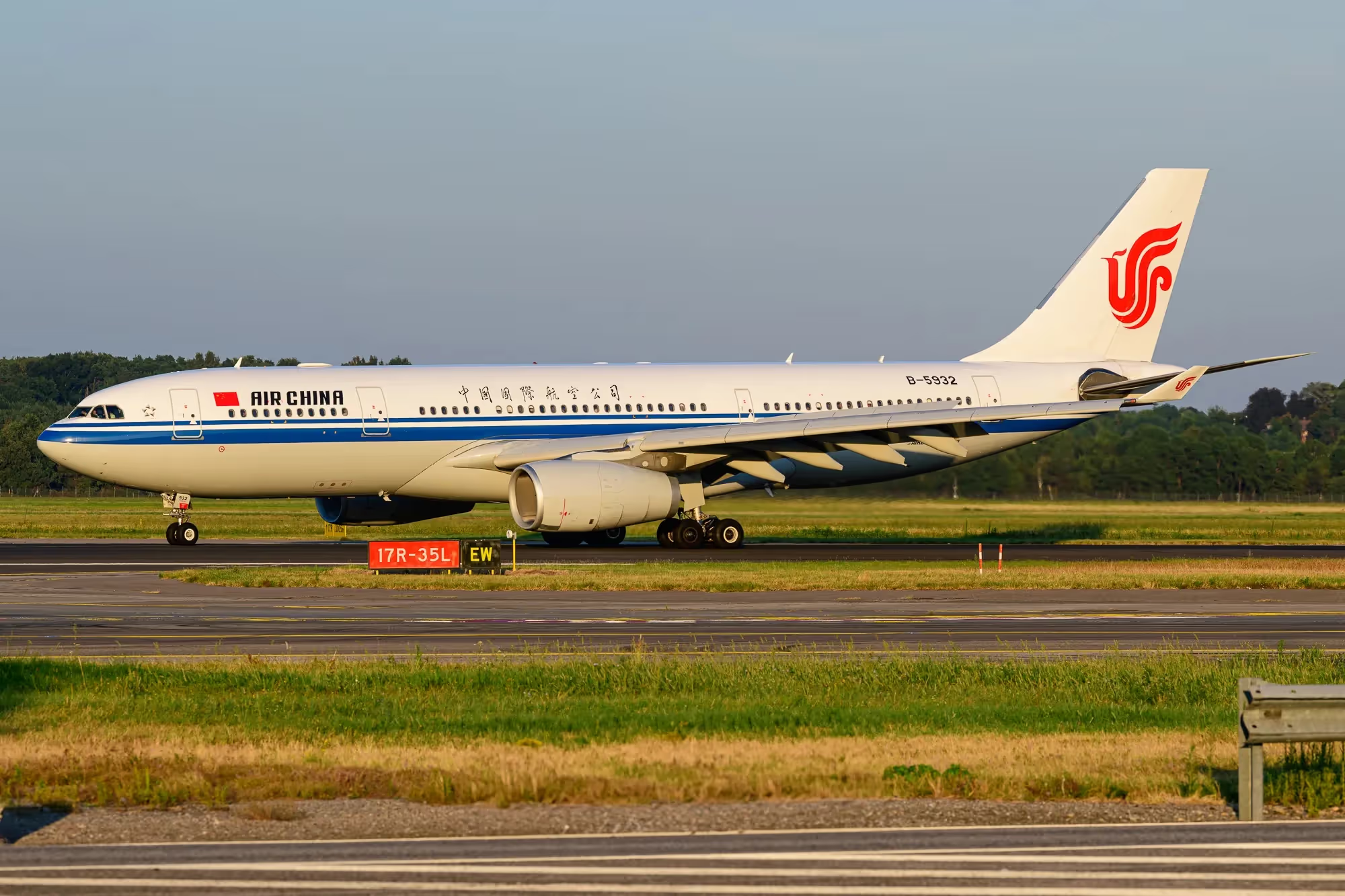
Air Greenland, the national carrier and flag airline, functions as the anchor tenant and primary operational partner. Air Greenland operates a mixed fleet including Airbus A330neo (wide-body long-haul), A330-200 (wide-body medium-haul), ATR 72 and Twin Otter turboprops (regional/domestic), and helicopter services.
2.2 National Ownership and Fiscal Commitment
Unlike many Arctic infrastructure projects driven by external investment, Greenland and Denmark have maintained majority equity and decision-making authority. This governance model reflects a deliberate rejection of the Chinese-financed model and a preference for Denmark-anchored financing through NIB and bilateral Danish government support.
The Greenlandic government committed to the airport package despite fiscal constraints (Greenland's GDP is ~DKK 18–20 billion annually, making this program ~20–25% of annual GDP when amortized over the construction period). This reflects political consensus that airport access is foundational to economic diversification and Arctic positioning.
3. Financing Architecture and International Participation
3.1 Financing Sources and Mechanisms
The three-airport program has been financed through a multi-layered structure:
Nordic Investment Bank (NIB) Financing
The Nordic Investment Bank, a multilateral institution owned by Denmark, Estonia, Finland, Iceland, Latvia, Lithuania, Norway, and Sweden, has been the primary institutional lender:
- July 2019 Loan Agreement: NIB extended DKK 450 million (EUR 63.3 million) to Kalaallit Airports International for Nuuk and Ilulissat airports[1].
- Terms: 20-year maturity, favorable pricing reflecting NIB's AAA/Aaa credit rating, and concessional lending mandate for regional development
- Coverage: Partial co-financing of runway construction, taxiway systems, terminal facilities, and air traffic control infrastructure
Danish Government Support
Denmark has provided both direct subsidies and sweetened loan packages to ensure project completion after Chinese offers were rejected:
- Direct capital grants: Estimated DKK 500 million–1+ billion across phases, directly injected by the Danish government or through the Ministry of Defense budget for Arctic security
- Sovereign guarantees: Backing of debt instruments to reduce borrowing costs
- Fiscal subsidy to Greenland: Greenland receives an annual block grant (self-government grant) from Denmark (~DKK 3.7 billion annually), portions of which have been redirected to airport infrastructure[2]
Project Costs and Allocation
Cost Escalation and Timeline Slippage
Original timelines (2023 completion for Nuuk and Ilulissat) have experienced consistent slippage:
- Nuuk: Originally 2023, moved to Q4 2024 (inaugurated November 28, 2024, after ~12-month delay)
- Ilulissat: Originally 2023, now expected Q2–Q3 2026 (18–24 month overrun)
- Qaqortoq: Remains in tendering; expected start 2025 with completion ~2027–2028
Cost drivers for overruns include Arctic construction challenges (permafrost, weather, short working seasons), scale of earthmoving required (12.5 million cubic meters of rock blasted for Nuuk and Ilulissat combined), supply chain constraints, and currency volatility (projects priced in EUR; Greenlandic costs indexed to DKK)[3].
3.2 The Blocked Chinese Bid: Geopolitical Inflection
In 2018, China Communications Construction Company (CCCC), a state-owned enterprise and a major player in global infrastructure, proposed to finance and construct airports in Greenland, reportedly offering more favorable terms than those available from traditional Western lenders. This offer triggered immediate concern in Copenhagen and Washington:
- Danish Response: Characterized the CCCC proposal as a strategic threat, citing concerns about critical infrastructure control, data security, and the Greenland-US military relationship (Thule Air Base)
- Financial Counter-Offer: Denmark responded with enhanced loan packages via NIB and bilateral support, effectively outbidding CCCC on price and political terms[4]
- Strategic Outcome: CCCC withdrew from Greenland airport competition by late 2018–early 2019, consolidating Danish-Nordic stewardship
This episode established a precedent: Western (particularly Denmark-UK-US-aligned) interests are prepared to use favorable financing to prevent Chinese state-owned enterprises from controlling critical Arctic infrastructure. It also signaled to Greenland that airport modernization could be weaponized in Great Power competition—a theme that would intensify after 2024.
4. Project Details, Status, and Operational Implications
4.1 Nuuk International Airport (Operational)
Infrastructure Specifications
Opening and Initial Operations
Inaugural flight: November 28, 2024, Air Greenland Airbus A330neo "Tuukkaq" (Greenlandic for "harpoon") from Copenhagen, crewed by Chief Executive Harald Rokke of NIB onboard as guest[5].
New routes (December 2024 onward):
- Copenhagen–Nuuk: 4 hours 50 minutes, daily service via Air Greenland, replacing domestic helicopter transfers from Kangerlussuaq
- New York (Newark)–Nuuk: United Airlines commenced scheduled service July 2025 (first direct transatlantic service to Greenland's capital)
- Icelandair and other carriers: Evaluating route expansion
Economic Implications
Cargo Benefits: The airport enables fresh seafood export, a transformative advantage for Greenland's fishing sector:
- Polar Seafoods and other processors have trialed airfreight; fresh shrimp and halibut can now reach markets in Copenhagen, London, and China within 24 hours, versus 4–5 days by container ship
- An estimated 20–30% value premium for fresh versus frozen product; potential market expansion estimated at DKK 200–400 million annually[6]
Passenger Traffic: Initial projections indicate 300,000–500,000 annual passengers by 2030 (compared with ~40,000 in 2023 across all Greenland airports). Tourism boards project 200,000–300,000 tourists annually by 2030, up from ~140,000 in 2023[7].
4.2 Ilulissat International Airport (Under Construction; Expected 2025–2026)
Infrastructure Specifications
Current Status and Timeline
- Construction start: Q2 2020
- Original completion: 2023
- Current expected completion: Q2–Q3 2026 (36-month delay)
- Cost escalation: Project costs increased ~15–20% from initial estimates, primarily due to Arctic construction challenges and supply chain disruption post-COVID
Strategic and Tourism Importance
Ilulissat is Greenland's premier tourism destination, home to the Ilulissat Icefjord (UNESCO World Heritage Site), a 40-km fjord that features calving by the Sermeq Kujalleq glacier. The airport's construction has been contentious:
- Community opposition: Initial local skepticism over noise impacts and environmental disruption, particularly concerning glacier-adjacent infrastructure
- Tourism opportunity: New 2,200-meter runway enables direct service from Iceland, Copenhagen, and potentially North American gateways; current tourist arrivals to Ilulissat are estimated at 40,000–50,000 annually; projections suggest 100,000+ with airport access[8]
- Regional hub function: Ilulissat serves as an air gateway to northern Greenland settlements (Uummannaq, Qaanaaq, etc.), enabling both tourism and supply chain logistics
4.3 Qaqortoq Regional Airport (Pre-Construction; Expected 2027–2028)
Infrastructure Specifications
Status and Challenges
- Development stage: Tendering phase as of January 2026; contractor selection expected Q2 2026
- Financing: Secured through Danish government + Greenland equity; separate financing mechanisms from Nuuk/Ilulissat (both covered by NIB)
- Timeline: Construction completion expected in April 2026
- Connectivity: Will serve southern Greenland and enable connections to Iqaluit (Canada) and regional hubs
Qaqortoq is Greenland's southern hub. The new airport is intended to support mining development (rare earths, critical minerals) in the south and facilitate tourism to southern fjords and communities. Regional development perspectives suggest Qaqortoq airport is as critical as Nuuk for spatial diversification of economic activity.
5. Air Greenland Operational Strategy and Network Development
5.1 Fleet and Route Evolution
Air Greenland's Fleet Composition:
- Airbus A330neo (1 aircraft): Wide-body long-haul, 278–300 seats (three-class), primary transatlantic carrier ("Tuukkaq")
- Airbus A330-200 (2 aircraft): Wide-body medium-haul, 239–280 seats, backup and secondary international routes
- DHC Dash-8-200: fixed wing for shorther domestic hops, replacing Dash 7s.
- Airbus H155 and H255 plus smaller AS350s for remote settlements.
Strategic Reorientation: The new airports enable Air Greenland to:
- Eliminate domestic helicopter transfers: Previously, passengers from Nuuk had to helicopter to Kangerlussuaq and connect; Nuuk International Airport eliminates this friction
- Reduce crew positioning deadheading: Direct Nuuk–Copenhagen service cuts operational costs
- Expand cargo: Fresh export and high-margin perishables become economically viable
- Pursue load factors: United and other carriers' entry increases competition but expands total traffic, benefiting Air Greenland through tourism stimulation[9]
5.2 Route Network Projections (2025–2027)
Confirmed/Planned Routes:
North American Expansion Possibilities:
- Reykjavik–Nuuk–Newark triangle: Potential for Icelandair 757/767 or future narrowbody widebody (A220-300, CS300) to operate via Nuuk, creating a "Greenland stopover" tourism/trade route
- Halifax–Nuuk: Canadian interest in Arctic connectivity; potential future route if demand scales
- European regional service: Discussions with SAS (Denmark) and other Scandinavian carriers regarding Copenhagen–Nuuk shuttle expansion
6. International Participation and Strategic Interests
6.1 Nordic Investment Bank and EU Engagement
The Nordic Investment Bank has positioned itself as the Western institutional anchor:
- Loan size and terms: DKK 450 million (EUR 63.3 million) at favorable rates; 20-year amortization aligned with infrastructure asset life
- Strategic signaling: NIB's involvement underscores Nordic/EU commitment to Arctic development as counterweight to non-Western actors
- Broader EU Arctic Strategy: Greenland airports align with EU Arctic Council objectives, critical minerals security (rare earths), and blue economy initiatives
The European Union has not provided direct financing but has engaged through:
- Raw materials security: EU interest in Greenland rare earths and mining logistics; airport infrastructure critical to cost-effective mineral transport
- Critical infrastructure resilience: EU cybersecurity and technology standards incorporated into airport system design
- Climate and research: Greenland's role in climate monitoring and Arctic science; airports essential for research access
6.2 Denmark's Sovereign Role and Strategic Signaling
Denmark's position reflects multiple strategic imperatives:
- Kingdom cohesion: Greenland's autonomy is constrained by economic dependency; airport funding reinforces Danish sovereignty and Greenlandic integration into Nordic/Danish frameworks
- Arctic geopolitics: Greenland airports position Denmark as the primary Arctic gateway for NATO and Western interests; stands against strategic competitors
- Fiscal commitment: DKK 500 million–1+ billion direct investment signals that Copenhagen views Greenland development as non-negotiable despite fiscal constraints
- Defense and security: Thule Air Base (US-operated, Greenlandic-hosted) benefits from improved logistics; better airports reduce US reliance on C-17/KC-135 rotations from CONUS
Danish Foreign Minister Lars Løkke Rasmussen's statement at the Nuuk opening: "By enhancing our infrastructure, we are paving the way for economic activity and stronger global ties," reflects a synthesis of economic and strategic framings[10].
6.3 United States Strategic Interest and Emerging Involvement
US interest in Greenland airports has intensified markedly since 2024:
Military/Defense Considerations:
- Thule Air Base logistics: Improved civilian airport infrastructure reduces airlift burden; potential for increased US military transits via Nuuk
- Arctic deterrence: US Space Force, Arctic operations, and NATO presence in Greenland depend on logistics; better airports enhance regional power projection
- Missile defense: Recent statements (January 2026) by US officials reference Greenland airports as part of a broader Arctic missile defense architecture[11]
Commercial/Economic Interest:
- United Airlines service: July 2025 launch of Newark–Nuuk service signals US carrier commitment; reflects both tourism upside and potential US business interest in Greenland mining and seafood supply chains
- Tech and infrastructure: US companies (potential participation in airport IT, cargo handling, terminal operations) competing for contracts
Emerging Geopolitical Dimensions:
- Trump administration (2025+) rhetoric regarding Greenland sovereignty and "strategic necessity" of US involvement has created ambiguity about US intentions beyond standard commercial interest
- Congressional Arctic interest: Bipartisan Congressional support for US Arctic engagement, including infrastructure; potential future US government support for transportation corridors
6.4 China and the Blocked Participation Model
Chinese strategic interest in Greenland remains evident, though participation in airports has been blocked:
CCCC Historical Bid (2018):
- Offered comprehensive financing and construction, proposed by China National Offshore Oil Corporation (CNOOC) and CCCC as an integrated Arctic resource development and logistics initiative
- Terms reportedly more favorable than eventual NIB/Danish package; included proposals for port development and mining logistics
Current Status:
- Effectively excluded: No Chinese companies in airport construction, operation, or financing
- Alternative engagement: Chinese interest in Greenland mining (rare earths) continues; mining logistics will depend on airport export capacity, creating an indirect Chinese benefit
- Intelligence and political concerns: Western strategic community views Chinese CCCC involvement as unacceptable due to data security, military access concerns, and broader Arctic competition dynamics[12]
Precedent and Policy Implication: The successful blocking of CCCC's participation, through Western financial counteroffers, established a model for defending Arctic infrastructure against non-aligned investment—a model being replicated across Arctic nations (Canada, Nordic countries).
7. Economic and Sectoral Impacts
7.1 Fisheries and Seafood Export
Greenland's primary export sector is fisheries, particularly shrimp and halibut. Airports enable:
- Fresh product export: Polar Seafoods and competitors can now export fresh seafood (not frozen) to premium markets; value uplift of 20–30% per unit
- Market expansion: Direct air links to Copenhagen, London, and North American markets previously unreachable for fresh product
- Supply chain compression: 4–5 day reduction in transport time; extends product shelf-life window and enables higher-margin, shorter-lead-order fulfillment
Economic scale: Greenland's fisheries exports ~70,000 metric tons annually, valued at ~DKK 4–5 billion. A fresh export premium could add DKK 200–400 million to the annual export value [13].
7.2 Mining and Rare Earths Development
Greenland's subsoil contains significant rare earth element (REE) deposits, including those near to Qaqortoq and due to the Uranium deposits in the area, the mining permit has been withdrawn. If the permit return for the Kvanefjeld/Kuannersuit project, operator Greenland Minerals Ltd., formerly Rare Element Resources, airports will be critical:
- Export logistics: REE concentrate is high-value, low-volume; air transport is economically viable for premium markets
- Project economics: Airport access reduces capex requirements for port infrastructure and transportation
- Permitting and development: Environmental and regulatory approval hinges partly on demonstrating viable (low-carbon, efficient) export logistics; airports support this case
7.3 Tourism Growth and Spatial Distribution
Tourism is the third pillar:
- Historical baseline: ~140,000 foreign tourists in 2023; 36.5% growth YoY from 2022 to 2023
- Projected growth: 200,000–300,000 annually by 2027–2030 with airport access
- Economic contribution: Tourism contributed DKK 1.9 billion (USD ~270 million) to Greenland economy in 2023, supporting ~1,075 jobs[14]
Spatial distribution challenge: Tourism is concentrated in Nuuk and Ilulissat. Government policy aims to disperse visitors to southern Greenland (via Qaqortoq airport) and northern settlements. Sustainability concerns include:
- Infrastructure strain: Small towns (Ilulissat ~4,700 residents; Qaqortoq ~3,000) face accommodation and service bottlenecks
- Environmental impact: Glacier and fjord tourism risks; icefjord visitor management protocols are nascent
- Social disruption: Rapid tourism growth creates cultural challenges; new tourism law (2024) attempts to manage growth
Visit Greenland and government position: The explicit policy is "controlled growth," with Tourism Minister Naaja Nathanielsen stating the goal is to "welcome tourists in bigger cities, but also spread them out more[15]."
7.4 Employment and Gross Domestic Product Impact
Direct employment:
- Airport operations (Greenland Airports): ~150–200 jobs across Nuuk, Ilulissat, Qaqortoq facilities
- Air Greenland expansion: +50–100 pilots, flight attendants, ground staff by 2027
- Tourism support services: Estimated +300–500 jobs by 2027 (hotels, restaurants, guides, transport)
GDP impact: Greenland's estimated 2024 GDP is approximately DKK 20 billion (USD 2.7 billion). Combined, tourism and fisheries increases are estimated at +DKK 300–500 million annually (1.5–2.5% GDP growth impact) by 2027–2028.
8. Risks, Challenges, and Uncertainties
8.1 Cost Overruns and Fiscal Sustainability
Risk factors:
- Arctic construction: Permafrost instability, extreme weather, short work seasons, and specialized expertise create endemic cost pressure
- Supply chain volatility: Post-COVID supply disruption and ongoing global logistics constraints; equipment for Arctic airports (ILS systems, specialized runway surfaces) has long lead times
- Currency exposure: Projects priced in EUR; Greenlandic budget in DKK; krone weakness increases costs
- Scope creep: Terminal expansions, additional taxiway systems, and future runway extensions not in the original budgets
Fiscal impact: Greenland government debt has increased ~30% in real terms over 2020–2024 to fund the airport program. Debt service will consume ~10–15% of government revenue by 2027, limiting future investment flexibility.
8.2 Demand Uncertainty and Revenue Projections
Risk factors:
- Tourism volatility: Projections of 200,000–300,000 annual tourists are optimistic; Arctic tourism is leisure-dependent and economically vulnerable; recession or geopolitical crisis could reduce traffic by 30–50%
- Airline commitments: United Airlines' Newark–Nuuk service depends on load factor sustainability; if loads fall below 65–70%, service could be withdrawn
- Mining uncertainty: Kvanefjeld REE project remains in permitting; if mining is blocked (environmental concerns), rare earths export does not materialize, reducing cargo traffic
- Seasonality: Greenland's tourism is heavily summer-weighted (June–September); winter traffic may remain thin, requiring subsidized off-season service
8.3 Environmental and Regulatory Compliance
Challenges:
- Permafrost and climate change: Airport infrastructure in northern latitudes faces accelerating permafrost thaw; runway thermal management systems require ongoing investment and monitoring
- Noise and wildlife: Ilulissat airport's proximity to glaciers and bird colonies creates regulatory compliance risks; mitigation measures may constrain operations
- Carbon footprint: New airport infrastructure and increased air traffic expand Greenland's aviation emissions; conflict with climate/ESG objectives
- Environmental impact assessments: Projects have been subject to local environmental review; future expansion may face tighter scrutiny
8.4 Geopolitical and Strategic Risks
Emerging uncertainties:
- US strategic interest volatility: Recent Trump administration rhetoric regarding Greenland has created uncertainty about US government intentions; potential future pressure for US control or military expansion could create political instability
- NATO and defense operations: Airports may be increasingly militarized for NATO Arctic operations; civilian-military dual-use conflicts are possible
- Danish-Greenlandic relations: Rising Greenlandic nationalism and independence sentiment; airports funded by Denmark could become a flashpoint if political relations deteriorate
- Arctic Great Power Competition: Continued US-China-Russia competition may intensify strategic stakes; Greenland airports could become contested terrain
9. Conclusion and Outlook
Greenland's airport modernization program represents the territory's most significant infrastructure investment and a strategic inflection point in Arctic connectivity. The completion of Nuuk International Airport in November 2024 marks the transition from planning to operation; the expected commissioning of Ilulissat and Qaqortoq airports by 2027–2028 will complete a three-tier network capable of supporting economic diversification and international integration.
Key achievements:
- Direct transatlantic connectivity from Nuuk, eliminating costly domestic transfers
- Fresh seafood export capacity supporting premium-market logistics
- Tourism infrastructure enabling sustainable growth in a strategic sector
- A successful West-anchored financing model that excluded non-aligned participation
Persisting challenges:
- Fiscal sustainability amid cost escalation and economic constraints
- Demand volatility and dependency on tourism and mining projects are still in permitting
- Environmental and permafrost adaptation as climate impacts accelerate
- Emerging geopolitical tensions as Arctic competition intensifies
Aviation industry outlook: For specialist aviators and aviation professionals, the Greenland airport program represents a rare opportunity to track how infrastructure modernization reshapes ultra-remote regional networks. Air Greenland's operational strategy, the entry of new carriers (United, Icelandair), and the technical specifications of the new airports (CAT III ILS systems, permafrost runway engineering, Arctic maintenance requirements) offer case studies in Arctic aviation resilience and commercial viability.
Strategic horizon (2026–2030): Barring major geopolitical or economic disruption, Greenland airports are likely to sustain 200,000–300,000 annual passengers and drive 1.5–2.5% incremental GDP growth through tourism and fisheries improvements. The question remaining is whether mining projects materialize (confirming cargo economics) and whether US-Denmark-Greenland relations remain stable amid heightened Arctic competition. Either outcome reshapes Greenland's role as an Arctic gateway and has implications for commercial aviation routing and regional connectivity.
References
[1] Nordic Investment Bank. (2019, July 19). NIB finances the development of Greenland airports [Press release]. Retrieved from https://www.nib.int/news/nib-finances-the-development-of-greenland-airports
[2] Marketplace/BBC. (2024, November 27). Will Greenland's new airport help its economy take off? Retrieved from https://www.marketplace.org/story/2024/11/27/will-greenlands-new-airport-help-its-economy-take-off
[3] Visit Greenland. (2024, May). Greenland's infrastructure and development plans. Retrieved from https://traveltrade.visitgreenland.com/latest-news/greenlands-infrastructure-and-development-plans/
[4] Kleimann, D. (2020). Greenland: What is China doing there and why? Presence Before Power, Clingendael Institute. Retrieved from https://www.clingendael.org/pub/2020/presence-before-power/4-greenland-what-is-china-doing-there-and-why/
[5] Nordic Investment Bank. (2024, December 12). A new gateway to Greenland's future. Retrieved from https://www.nib.int/articles/a-gateway-to-greenlands-future
[6] Marketplace/BBC. (2024, November 27). Ibid.
[7] Visit Greenland. (2024, December). Tourism statistics and projections. Internal data; Visit Greenland official briefing materials.
[8] Marketplace/BBC. (2024, November 27). Ibid.
[9] Air Greenland Group. (2024). Annual Report 2024. Greenlandic national carrier's annual financial and operational reporting.
[10] Nordic Investment Bank. (2024, December 12). Ibid.
[11] Eurasian Times. (2026, January 13). Greenland 'vital' for Golden Dome missile shield, Trump says. Retrieved from https://www.eurasiantimes.com/greenland-vital-for-golden-dome-missile-shield-trump-says-distrust-of-europe-fuels-arctic-push-u-s
[12] CSIS. (2026, January 7). Greenland, rare earths, and Arctic security. Center for Strategic and International Studies analysis.
[13] Marketplace/BBC. (2024, November 27). Ibid.
[14] Nordic Investment Bank. (2024, December 12). Ibid.
[15] Marketplace/BBC. (2024, November 27). Ibid.
Featured image: Sharad Ranabhat/Airways




.avif)