

.webp)
.webp)
.webp)
.webp)
WASHINGTON, D.C. — Driven by National Transportation Safety Board (NTSB) recommendations, the Federal Aviation Administration (FAA) has finalized a long-anticipated rule requiring cockpit voice recorders (CVRs) on U.S. airliners to capture at least 25 hours of audio, replacing the long-standing 2-hour standard. The FAA officially moved to a mandatory 2-hour minimum recording duration for CVRs in 2008, replacing the previous 30-minute standard.
Regulators have argued that the shorter recording window has repeatedly erased critical evidence before investigators could access it. According to the FAA, more than a dozen accidents and incidents since 2003 would have benefited from longer audio retention, but the recordings had already been overwritten by the time investigators obtained the aircraft.
The rule follows a commitment made after the FAA’s 2023 Safety Summit, where industry leaders called for stronger data capture to support accident investigations.
Under the new regulation:
- All newly manufactured aircraft delivered from 2027 onward must be equipped with 25-hour CVRs.
- Existing passenger aircraft must be retrofitted with the longer-duration recorders by 2030.
The change brings U.S. requirements in line with standards already adopted internationally by the International Civil Aviation Organization (ICAO) and Europe’s European Union Aviation Safety Agency (EASA), both of which moved to 25-hour recordings after several high-profile investigations were hampered by overwritten cockpit audio.
Cockpit voice recorders capture sounds inside the flight deck, including pilot conversations, radio calls, alarms, and background noise. Unlike flight data recorders, which store technical parameters, CVRs provide context about crew actions and communication in the minutes and hours leading up to an event.
Omitting what pilot unions might say on the matter, particularly privacy concerns, the consensus view among many professional pilots is that longer recordings are fine for safety investigations, as long as the data is tightly protected and not turned into a surveillance tool.
A Call to Increase CVR Recording Time
A commitment was made after the FAA’s 2023 Safety Summit, where industry leaders called for stronger data capture to support accident investigations. On January 8, 2024, on the first day of the investigation surrounding the Alaska Airlines (AS) Boeing 737-9 door-plug blowout incident, NTSB Chair Jennifer Homendy called for the FAA to propose an increase in the cockpit voice recording time from 2 hours to 25 hours on all planes in the air, not just newly manufactured ones.
At the time, the NTSB had sent the CVR and flight data recorder (FDR) to their labs. They were tasked to use FDR data to narrow the search area for the door plug. However, the CVR was completely overwritten, leaving it blank. This had happened before in previous runway incursion incidents, hampering "several investigations."
The Chair said the NTSB had "many times talked about the need to increase the time on CVRs from 2 hours to 25 hours, which is consistent with Europe and many other countries. The FAA has recently issued a notice of proposed rulemaking for such a time extension, but only for newly manufactured aircraft. The planes that are in service now have a life cycle of 40 to 50 years, meaning those planes will not have the time extension on their CVRs."
CVRs are critical for accurately pinpointing what is happening in the cockpit during an aircraft incident or accident. The NTSB Chair recalled the maxim: Aviate, navigate, and communicate, adding that “if that communication was not recorded, it was a loss for us, a loss for the FAA, and a loss for aviation safety."
The Chair was adamant when she stated that the NTSB was "making comments on the FAA's rulemaking, calling for 25-hour CVRs in not just new aircraft but retrofitting aircraft, and if the FAA won't do it, we hope Congress will take action in the FAA reauthorization bill to ensure that it does. I cannot emphasize enough how important that is for safety."
The NTSB has pushed for this upgrade since 2018. The FAA published the proposed rule on December 3, 2023, opening a public comment period that ran through February 2, 2024 and generated 118 submissions.
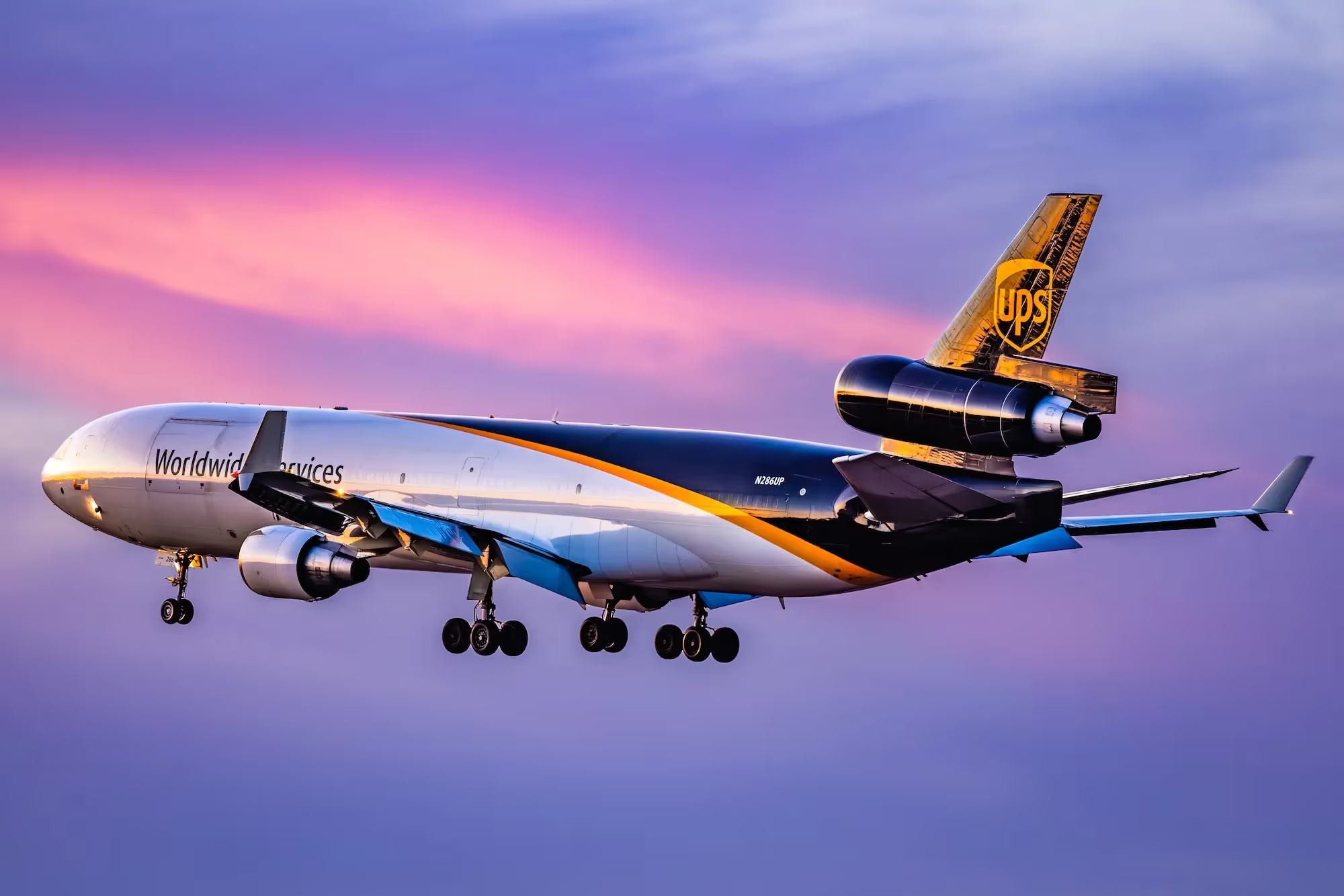
Featured image: Lorenzo Giacobbo/Airways



.avif)