Air Canada Launches Cabin Refresh, Debuting on A321XLR, 787-10 This Year

MONTRÉAL — “Glowing Hearted” is the name Air Canada (AC) has given to its new design standard for the passenger cabins, the first major expression of which was unveiled today at the Aircraft Interiors Expo in Hamburg, on board the incoming Airbus A321XLR and Boeing 787-10 aircraft later this year.
The new cabins include significant refinements on the new jets, but many updates will also find their way onto the rest of the fleet, particularly as cabin refits continue with former Rouge (RV) Airbus narrowbodies that were transferred to mainline AC, and Jazz (QK)-operated Air Canada Express aircraft receive updates.
“This investment is about fundamentally redefining the experience of flying with Air Canada. From the moment of stepping on board, we’re setting a new standard for how Canadians and the world connect with our brand,” said Executive Vice President & Chief Operations Officer at Air Canada, Mark Nasr. “Details matter: we listened closely to feedback and challenged ourselves to create an experience defined by a strong Canadian sense of place, alongside a commitment to craftsmanship, functionality, and long-term durability. This investment in the care and comfort of our customers is a key element of our New Frontiers growth strategy to become one of the world's leading airlines.”
The new cabin design, which was first teased in late 2024 during an investor report, will first appear on the airline’s Montréal (YUL)-based Airbus A321XLR, which will join the fleet ahead of the 2026 IATA summer season, followed by the Toronto (YYZ)-based Boeing 787-10 in Q4.
So, what’s new?

The overall
By far the most noticeable difference is the color palette and design elements inspired by Canada.
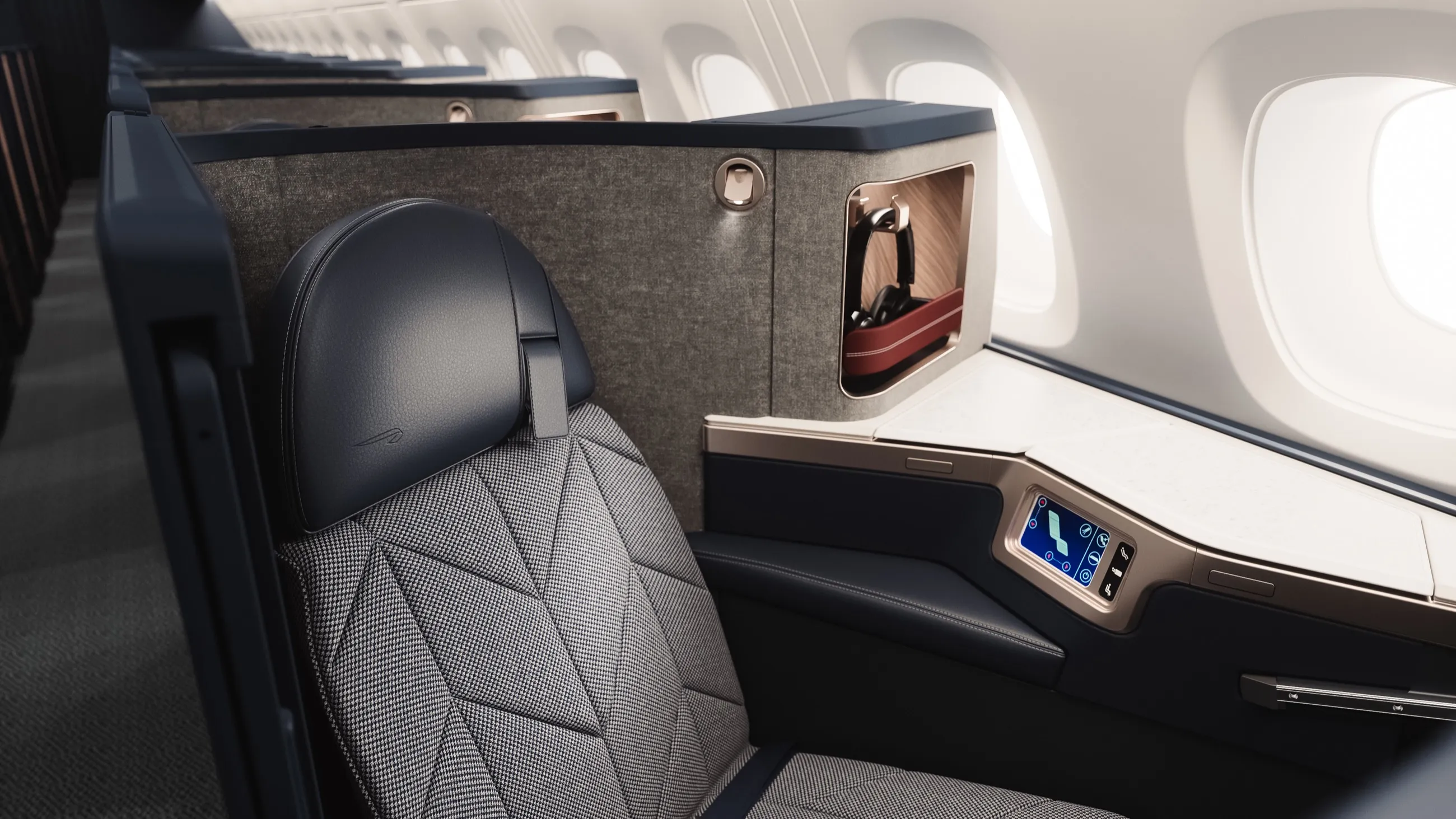
The new overall design takes a warmer, cozier, and more natural approach, particularly with the introduction of deep reds, wood, and bronzes, versus the bright but monochrome palette currently found on most of the fleet.
Quoting the press release, Air Canada details key design features across both the A321XLR and 787-10:
- Air Canada Signature red stitching and bespoke fabrics provide a subtle Canadian touch paired with a palette of greys and stone.
- Natural wood grain details are complemented by bronze metal accents.
- Leather-grain surfaces and metal finishes reflect deliberate investment in enduring quality, balancing refined aesthetics and durability.
“The new cabin design is inspired by Canada, creating a thoroughly modern space that evokes a sense of calm.”
On the functional side of things, the Glowing Hearted cabins will introduce larger Bluetooth audio-enabled 4K OLED In-Flight Entertainment (IFE) screens at every seat, in varying sizes; all-new seats with built-in tablet holders; larger overhead bins; and USB-C and AC outlets at every seat.
The carrier also teased a new “end-to-end hospitality experience” to be unveiled later this year, including “upgraded service, food and beverage elements and elevated amenities,” emphasizing that it will be “distinctly Canadian”.

Airbus A321XLR
At the L1 door, all passengers are welcomed by a maple leaf canopy overhead.
As with many other XLR operators, Air Canada will opt for a 14-seat Signature Class with lie-flat seats, the first narrowbody in the fleet to feature a full lie-flat option. The seats, Collins Aerospace’s Aurora (the same found on American’s (AA) own A321XLR), are arranged in a herringbone 1-1 configuration facing the aisle, complete with a 19-inch Bluetooth audio 4K OLED that folds out from the forward side-wall and more storage options.
The aircraft will also feature 168 economy-class seats in a standard 3-3 layout. AC chose Collins’ Meridian+ with the same IFE screen as in Signature, in a smaller 13-inch package, a bi-fold tray table with a built-in personal device holder, and multiple personal storage options in the seat-back. The first 6 rows, which represent 36 seats, will be sold as Preferred+, with extra legroom.
Air Canada has 30 firm orders for the type with deliveries beginning in the next few weeks as C-GXLR wraps up flight testing and customer demonstration flights at Hamburg Finkenwerder (XFW). AC is expected to take up to 11 jets by year’s end. As stated in September 2025, it is not clear if this is still the case, as the initial Q1 delivery timeline has now slipped. The first XLR is to be delivered in less than two weeks.
The XLR’s first new destination will be Palma de Mallorca (PMI) beginning June 17.

Boeing 787-10
14 firm orders for the extended Dreamliners have been placed by Air Canada, with deliveries beginning in the fall and two by the end of the year.
The new aircraft will be configured with 42 Signature Class, 28 premium, and 262 economy class seats, for a total of 332 seats. Compared to the smaller 787-9, these cabins represent a 40% increase in Signature capacity, a 33% increase in premium economy, and an 11% increase overall.
“Premium passengers are greeted by a wave-like entrance monument, inspired by Canada’s waterways and anchored by the Air Canada rondelle cast in bronze,” the airline said in the announcement. The design is featured on the rear bulkhead, while the forward bulkhead is a simple wood-inspired design with “Signature” branding, also featured on the A321XLR.
Beginning up at row 1, the carrier is introducing brand new “Signature Plus Suites” with larger beds, 27-inch Bluetooth audio 4K OLED screens, and an additional rear-facing belted seat allowing for face to face visitation between passengers, all complete with higher walls and a fully retractable centre privacy panel for the centre two suites, meaning up to 4 passengers have space to socialize in the same shared space. The seats are exclusive to the 787-10, for now.
The rest of Signature Class is made up of 38 seats in a 1-2-1 reverse herringbone layout with a smaller 19-inch IFE screen and privacy panel for the middle two rows, akin to what is featured currently on AC’s widebody fleet, all tied together with a privacy door, another key difference from the XLR. The new seats are Elevate’s Ascent model, used by United (UA), American (AA), Qatar Airways (QR), and Alaska Airlines (AS).
Premium economy introduces privacy wings for the first time on the carrier, along with 16-inch IFE screens and armrest storage, similar to current premium economy and domestic business class seats. Air Canada went for Recaro here.
Finally, the economy will feature the same 13-inch IFE screens, accent lighting, enhanced storage in the lower seatback pockets, and a tablet dock built into the tray table.

The rest of the fleet
In today's announcement, Air Canada noted that it was upgrading cabins on other fleet types, including former Rouge Airbus A320 and A321, as they move to mainline in exchange for mainline’s 737-8s.
All five of Rouge’s A320 and 13 A321 will be transferred by 2027. 4 A321s have already been transferred beginning in late 2024. 4 737-8s have also made their way to Rouge, in a configuration that adds 2 rows of economy seating in exchange for a row of business-class seats. All 737s will be transferred by 2028.
Additionally, upgrades have been rolling out for Jazz-operated regional aircraft. 25 De Havilland Canada Dash 8-400s are undergoing full cabin redesigns with new Expliseat seats and interiors, as well as new Wi-Fi on select planes, based at Toronto’s Billy Bishop Airport (YTZ). The refurbishment is occurring in stages throughout this year, with completion by mid-year. Jazz operates 35 of the type on behalf of Air Canada Express with 78 seats.
The E175 and CRJ-900 jets will also be receiving new cabins from 2026, with Jazz operating 25 and 35, respectively, both in 12 business and 64 economy layouts.
Check out all the images from the new cabin offering here.



.avif)