Air France-KLM Beats Q2 Expectations, Cuts Capacity Growth Again


.webp)
.webp)
.webp)
.webp)
PARIS — Air France-KLM reported a better-than-expected second-quarter operating profit on Thursday, even as a sharply higher fuel bill reduced its margin and prompted the group to narrow planned capacity growth for a second time in 2026.
The group generated €484 million in adjusted operating profit for the three months ended June 30. That was €144 million above the €340 million median in Air France-KLM's company-compiled analyst consensus, but €251 million below the restated result from the same quarter last year.
Reuters characterized the result as an earnings beat accompanied by another capacity revision. The distinction between those two developments is important: revenue management worked better than expected during the quarter, while the revised guidance makes the group more selective about capacity planned through year-end.
Revenue increased 9.9%, while adjusted operating margin fell 3.5 percentage points to 5.2%. The apparent contradiction is explained by fuel: Air France-KLM earned more from each unit of capacity, but the additional revenue did not fully offset the increased cost of operating that capacity.
Capacity Is Still Growing, Just More Slowly
Air France-KLM now expects full-year group capacity, measured in available seat kilometers, to increase 2%–3% over 2025. The group had planned 3%–5% growth when it published its full-year 2025 results in February, then lowered the range to 2%–4% in its April first-quarter update.
The July guidance therefore represents a second reduction in expected growth. It is not guidance for a 2%–3% decline in total capacity.
The latest plan calls for long-haul network capacity to grow about 2%, down from a 2%–4% range. Short- and medium-haul network capacity is expected to decline about 1% instead of remaining flat, while low-cost unit Transavia—comprising Transavia France (TO) and Transavia Netherlands (HV)—is expected to grow about 8%, against the previous 8%–10% range.
Air France-KLM described the change as active capacity management intended to optimize returns in a volatile environment. The earnings release did not identify routes or frequencies that will be removed, making it too early to translate the group-level revision into specific passenger itinerary changes.
The second-quarter operating statistics show why that distinction matters. Group capacity increased 2.6% and traffic increased 2.5%, leaving load factor broadly stable at 87.7%. Air France-KLM carried 28.3 million passengers, 3.9% more than a year earlier. The latest guidance does not reverse that growth; it reduces how much additional capacity the group plans to produce over the full year.
Pricing Recovered Most, but Not All, of the Fuel Shock
The results release attributes an €804 million year-over-year headwind to higher fuel prices, including €26 million associated with the European Union Emissions Trading System. Fuel and carbon-quota expense rose 45% to €2.444 billion.
Air France-KLM estimated that its commercial actions recovered about 85% of the fuel-price effect through revenue, better than its earlier expectation of about 60%. The financial bridge identifies a €672 million benefit from higher unit revenue, approximately 84% of the €804 million fuel headwind and consistent with the group's rounded estimate.
"Fuel recapture" is a management measure rather than a separate line of revenue. It compares the additional unit revenue associated with fares, surcharges, cabin mix, and cargo pricing against the added fuel-price cost. It does not mean fuel became cheaper or that customers paid a single surcharge equal to 85% of the increase.
Group unit revenue increased 8.7% at constant currency. Passenger Network yield increased 9.2%, with double-digit growth in the front cabins, a 9.1% increase in Premium yield, and a 6.1% increase in Economy yield. Air France-KLM said Asia, North America, and the Caribbean and Indian Ocean region performed particularly well.
Premium demand therefore did more than provide a favorable mix. Higher-yielding cabins helped the group spread a larger fuel bill across each available seat kilometer. The same pricing support may become harder to sustain if competing capacity returns or demand weakens, which helps explain why a quarterly earnings beat can coexist with more conservative capacity planning.
The group now expects a US$8.9 billion fuel bill in 2026, below the US$9.3 billion estimate it provided in April but still US$2.0 billion above 2025. It said 67% of expected 2026 consumption and 40% of 2027 consumption were hedged.
Hedges can soften or delay a price shock without removing it. Airways has previously explained how fuel hedging interacts with airline fares, schedules, and margins. Air France-KLM expects a US$1.6 billion full-year hedging result, yet the second-quarter operating margin still contracted substantially.
Cargo Provided the Strongest Unit-Revenue Lift
Cargo was the quarter's clearest source of incremental pricing power. Air France-KLM's cargo capacity increased 2.9%, while traffic rose 11.3%. The resulting 3.7-point increase in load factor to 49.2% combined with higher yields to lift cargo unit revenue 26.7% at constant currency.
The group attributed the performance to reduced industry capacity during the Middle East disruption and demand for semiconductors and artificial-intelligence hardware. Cargo revenue rose 25.7% to €711 million.
That contribution is operationally significant because much of Air France-KLM's cargo moves in the holds of passenger aircraft. Strong freight demand can improve the economics of a passenger flight without adding more seats. It also helps explain why the Network business said it fully offset its fuel-price headwind even though the group as a whole recovered about 85%.
The advantage may moderate. Air France-KLM said Gulf-hub capacity was returning toward prewar levels by the end of the quarter. As that capacity normalizes, the temporary scarcity that supported passenger and cargo pricing on some Asia lanes should diminish.
Air France, KLM, and Transavia Had Different Quarters
The group result also masks a sharp difference between the two network airlines. Air France (AF) adjusted operating profit fell €290 million to €225 million, cutting its margin from 10.0% to 4.1%. Air France-KLM attributed the decline to higher fuel, salary, maintenance, and flight-related costs, partly offset by passenger and cargo unit revenue.
KLM (KL) held adjusted operating profit broadly stable at €176 million, up €3 million, despite a 48.8% increase in fuel expense. The airline said productivity improvements under its Back on Track program and reduced use of wet-leased aircraft helped offset higher pay and maintenance costs. Airways previously examined KLM's Back on Track progress in its 2025 results.
Transavia's figures show why high passenger growth alone does not guarantee profitability. Its two airlines carried 13.3% more passengers, increased traffic faster than capacity, and raised load factor 1.7 points to 91.2%. Even so, the business swung to a €35 million adjusted operating loss as its fuel expense increased 50.1%.
Transavia is moving from Boeing 737s to Airbus A320neo-family aircraft while absorbing former Air France flying at Paris Orly Airport (ORY). It also canceled service to Israel, Lebanon, and Saudi Arabia and reported weaker booking trends to nearby leisure markets. The decision to bring planned Transavia growth down to about 8% gives the group less exposure to adding marginal capacity while those pressures remain unresolved.
Looking Forward
Air France-KLM enters the second half with €10.3 billion in cash, €8.376 billion in net debt, and leverage of 1.6 times trailing adjusted EBITDA. Unit-cost guidance remains unchanged at growth of 0%–2%, while expected net capital expenditure remains below €3 billion.
The group therefore is not presenting the capacity revision as an emergency retrenchment. It is protecting yields and route returns while absorbing a fuel shock that has already led IATA to halve its 2026 global airline profit forecast.
For passengers, the practical effect remains uncertain until Air France, KLM, and Transavia publish route-level changes. The earnings release confirms fewer additional seat kilometers than the group planned earlier this year, but it does not confirm that a particular booked flight will be canceled.
The next results will show whether premium demand and cargo pricing remain strong as Gulf-carrier capacity returns, whether Transavia converts traffic growth into profit, and whether Air France can close the cost-performance gap with KLM. Those questions matter more to the full-year result than the headline earnings beat alone.
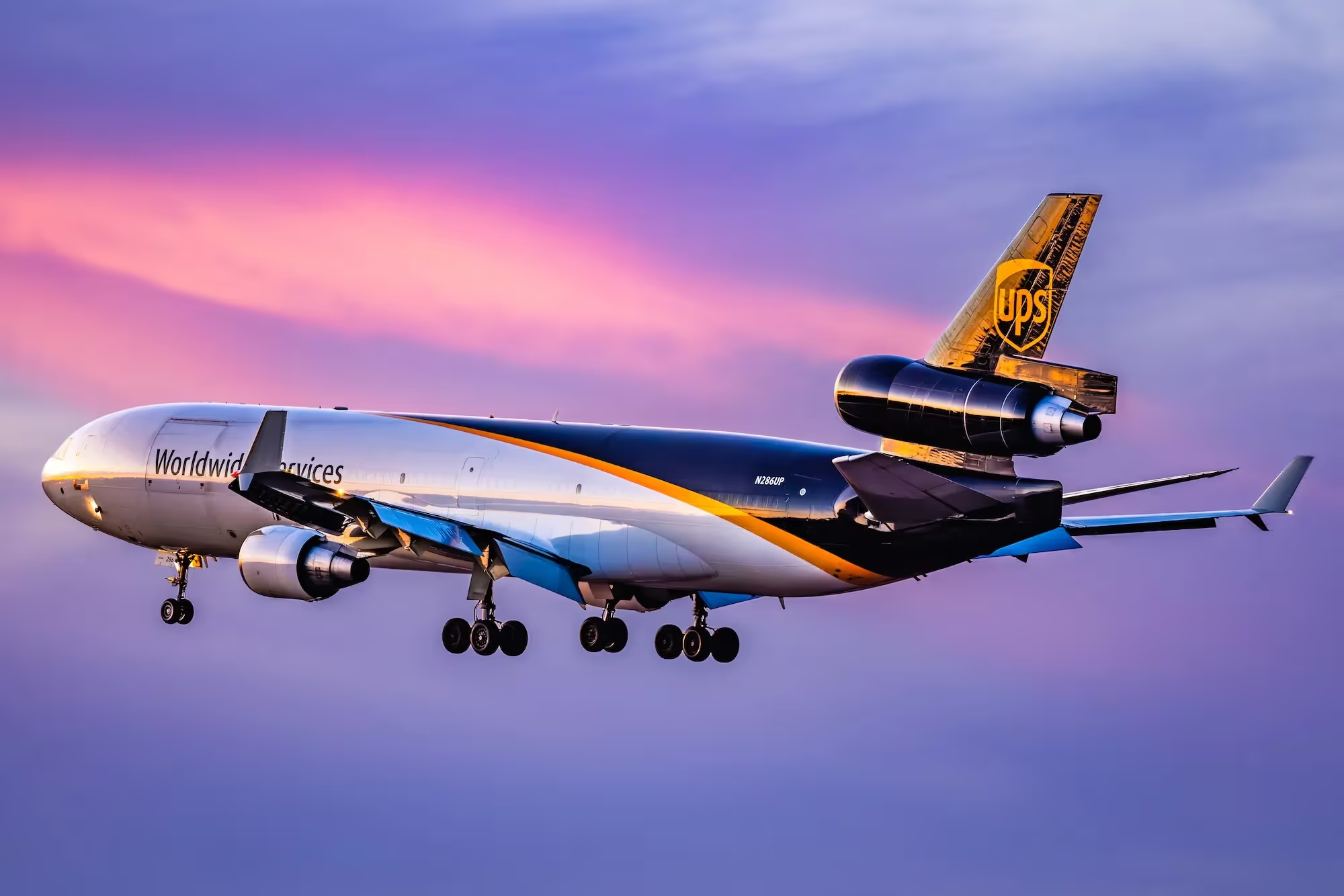
Featured image: Michael Rodeback/Airways



.avif)