Eve Air Mobility Brings Eve 100 Certification Push to Farnborough


.webp)


FARNBOROUGH — As this year's Farnborough Airshow marks the 78th year of its operations, much has been anticipated with regard to commercial aviation, engine manufacturers, and sustainable operations – both financially and environmentally. With one of the main priorities being the final-mile connection, there is significant drive, innovation, and development in Urban Air Mobility (UAM).
Day 0 of FIA2026 started with a media briefing from Eve Air Mobility, the Brazilian electric vertical takeoff and landing (eVTOL) aircraft developer, presenting the latest updates on the Eve 100 beside the aircraft mock-up. For the first time at the air show, Eve Air Mobility also presented its cockpit simulator, where the media had the opportunity to get a hands-on feel for flying the UAM air taxi.

Certification Timeline
One of the key topics heard almost every day in the commercial aviation industry is aircraft certification timelines. Although the UAM industry has experienced certification delays in the past, Eve has completed the first step in its flight-testing campaign, marking an important milestone in the overall certification process.
In December 2025, Eve conducted its first low-speed hover test at its test facility in Gavião Peixoto, São Paulo, Brazil. Since then, a total of 58 flight tests had been completed by early summer this year, as explained by Mr Johann Bordais, CEO of Eve Air Mobility. As recently as a couple of days before the briefing, Mr Bordais said the team had completed the initial transition phase of flight. He expects this phase of flight testing to gradually expand to 50 knots, then to 90 knots by the fourth quarter of 2026. Although this may appear to be a steep climb, Mr Bordais explained the certification timeline with confidence.
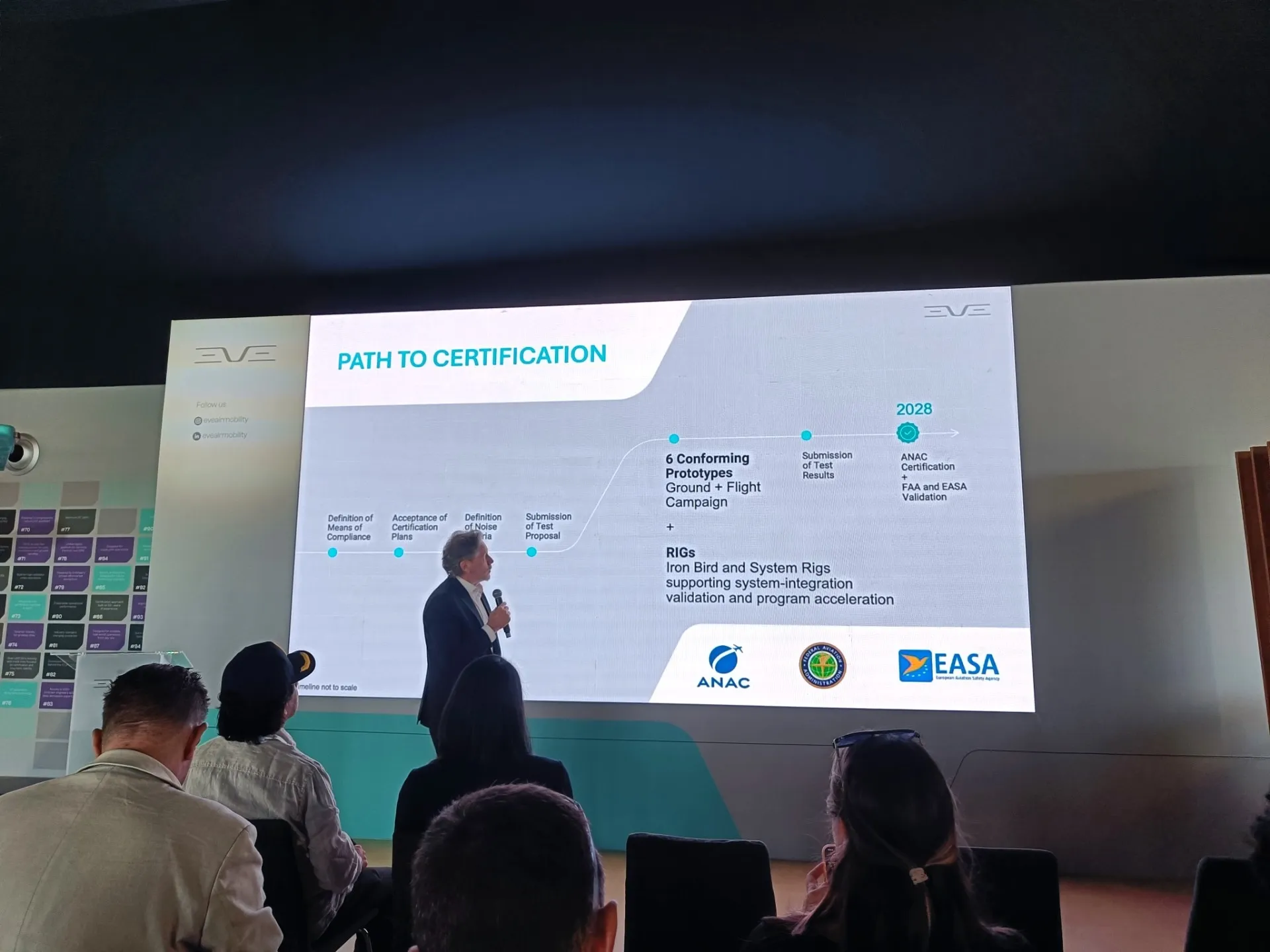
Data from rotorcraft certification served as a valuable starting point in estimating flight-test parameters such as loads, vibrations, noise, and flight-envelope limits. From defining the means of compliance and establishing noise certification criteria to submitting test proposals and conducting ground and flight-test campaigns with six prototypes, Eve aims to achieve certification from Brazil’s Civil Aviation Agency (ANAC), followed by FAA and EASA validation by 2028.
Some of the main challenges faced by the UAM industry include battery energy density, charging capability, noise levels, and low-altitude air traffic management systems. Eve aims to achieve noise levels below the limits mandated by ANAC and the FAA, and remains confident of reaching this target, particularly because of its aircraft design. Aircraft noise is perceived in multiple ways, including absolute sound pressure levels and frequency characteristics. Eve has incorporated these considerations into the aircraft design to comply with noise regulations throughout all phases of flight. Furthermore, ANAC has published noise certification criteria specifically for the Eve 100 to better understand the aircraft's acoustic characteristics.
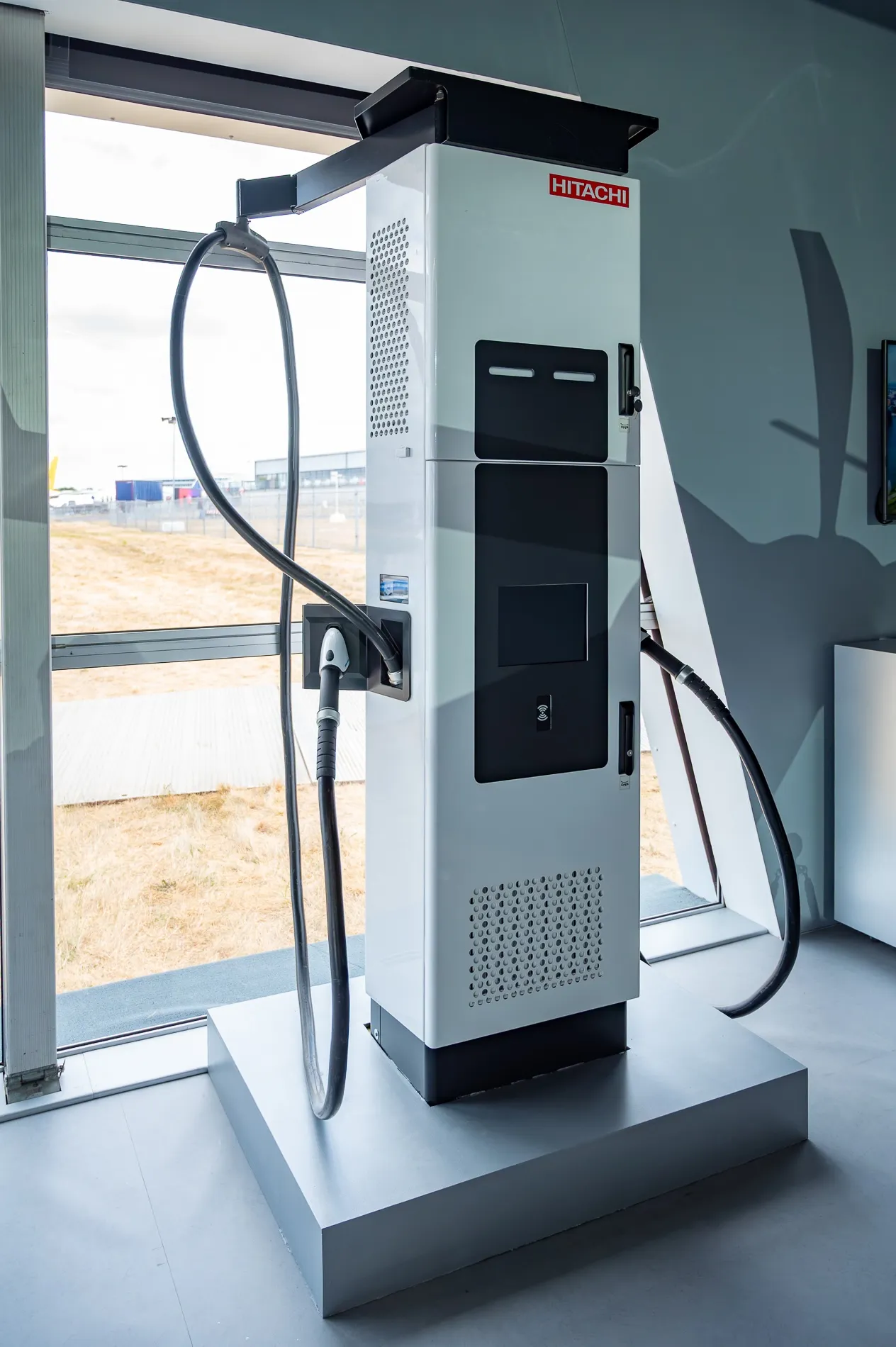
To address high-power charging infrastructure, Eve entered into a partnership with Hitachi Energy. The partnership aims to assess vertiport energy and charging requirements, explore the second life of aircraft battery systems, and support the scaling and global deployment of charging infrastructure. Currently, the Eve 100 is compatible with the CCS2 (Combined Charging System Type 2) charging system, which is already widely used for electric vehicle charging.
Commercial Outlook
Ms Megha Bhatia, Chief Commercial Officer of Eve Air Mobility, briefly presented the firm's order book along with a number of recent letters of intent (LOIs) for the eVTOL aircraft. To date, Eve has secured 100 firm orders, with 50 announced for Revo, an advanced air mobility operator based in São Paulo, during the Paris Air Show 2025, and another 50 from AirX in February 2026. In total, the company has accumulated approximately 2,700 aircraft commitments.
Ms Bhatia also presented the LOI signed with Moov, a Switzerland-incorporated aviation company, for up to 30 eVTOL aircraft to explore tourism and mobility opportunities across Cabo Verde and Europe. The Eve 100 is expected to be deployed for sightseeing, shuttle services, and regional mobility between São Vicente, Santo Antão, Sal, Praia, and Boa Vista.
Furthermore, Eve Air Mobility has signed an LOI with Shearwater Global Capital, the aviation finance company of Bay Point, for up to 16 eVTOL aircraft. The agreement forms part of the company's strategy to broaden its aviation finance platform by incorporating emerging asset classes such as Urban Air Mobility.
Featured/All Image: Shyam VimalKumar/Airways



.avif)