


.webp)
.webp)
.webp)
.webp)
DALLAS — Every time a commercial plane takes to the air, it enters a world pervaded by unseen forces, none more dramatic than lightning.
Since planes fly regularly through storm systems at high altitudes, lightning strikes are not merely to be expected but statistically unavoidable, occurring approximately once every 1,000 flight hours. And despite the raw energy of these natural electrical discharges, modern commercial airliners emerge unharmed, their systems still functioning, and passengers remain unaware.
This incredible safety record is not a product of luck, but rather a result of decades of careful engineering, strict certification, and sophisticated materials science.
Airplanes are designed to withstand lightning strikes safely, with design elements that redirect electrical energy away from fuel tanks and life-critical systems. Lightning protection techniques are changing as materials such as carbon composites and electric propulsion become more prevalent. Aviation confronts nature's wrath not by evading it, but by dominating it with design.
A Common Threat with Managed Risk
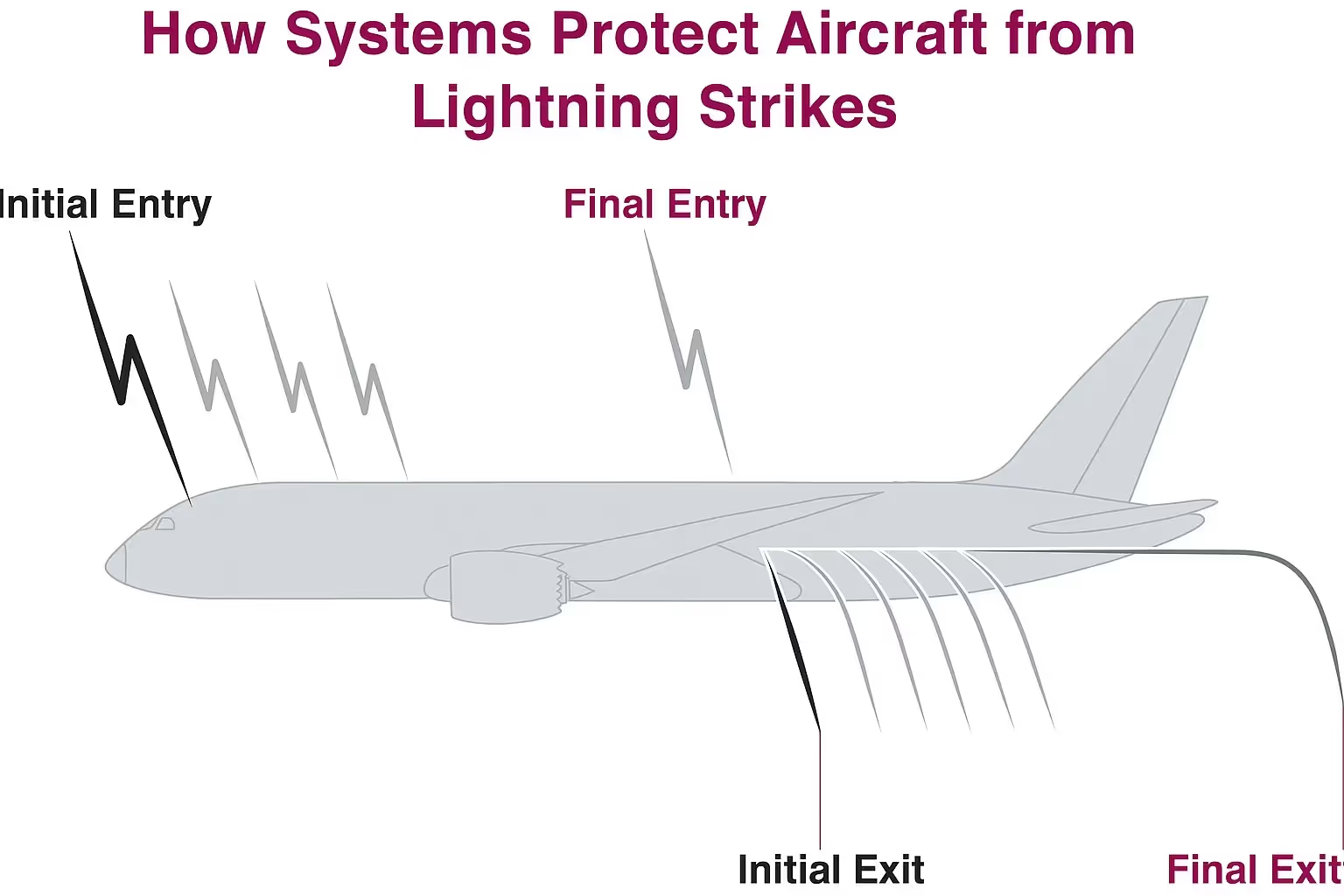
Lightning strikes on aircraft are typically encountered during climb, descent, or flying through cumulonimbus clouds in the vicinity of frontal systems. The intersection between the fuselage of the plane and charged parts of the atmosphere causes a strike, most commonly entering the nose or tip of the wing and discharging at the tail or another extremity.
While dramatic in presentation, lightning strikes are essentially harmless owing to sophisticated design techniques and strict certification procedures. The industry's strategy for lightning protection includes structural design, material science, bonding and grounding, system shielding, and operational inspection procedures.
Lightning Physics Meets Aerodynamics
A lightning discharge to an airplane encompasses currents of 200,000 amperes or greater, and temperatures of 30,000°C (54,000°F). The external skin of an aircraft is the most critical path for the energy, enabling it to travel harmlessly from entry to exit. The aircraft must prevent internal arcing, sparking, or fuel burning while maintaining structural strength.
Metal planes such as the Boeing 737 employ their aluminum surfaces as natural Faraday cages to protect internal systems. For composites like the Boeing 787 or Airbus A350, the problem is exacerbated by the lower conductivity of carbon fiber-reinforced plastic (CFRP). The planes must employ embedded expanded copper foil (ECF) or metal mesh layers to mimic the conductive paths of metallic implementations.
Lightning diverter strips are installed on radomes, winglets, and composite panels, as specified in Boeing's 737 Airport Characteristics Manual. These parts provide controlled discharge channels for high-voltage applications and shield radar and sensor systems.
Aircraft Design Features for Lightning Protection
Aircraft manufacturers must address both direct effects (such as structural damage and surface burns) and indirect effects (like induced transients that impact avionics) to obtain lightning protection certification. The design approaches can be classified into five main categories:
1. Faraday Cage Effect (Conductive Outer Layer)
Lightning current naturally bypasses the metal-skinned aircraft fuselage. To achieve this effect on composite aircraft, a conductive layer, such as foil or metal mesh, must be added. With this, localized heating at attachment points is prevented and even current flow ensured.
2. Grounding and Bonding
To prevent arcing, metal airplane components are electrically bonded and secured together with minimal resistance. Grounding straps and bonding jumpers provide a low-resistance, predictable flow for the current to follow.
3. Strike Terminals, Diverter Strips
Diverter strips are lightning's favorite points of attachment on non-metallic structures, such as radomes or winglets. They are designed to absorb the impact force and transmit it across the surface in a safe manner. On composite structures, these markings are often seen in the form of segmented or zigzag patterns.
4. System Shielding
The wiring of an aircraft, especially the avionics, navigation, and flight control systems, is shielded from damage by braided metal sheaths. Surge protection devices are installed to prevent transient voltages, and sensitive components are housed in Faraday cages or shielded enclosures.
5. Isolation of the Fuel System
The fuel tank is one of the most critical areas that require protection. Designers must ensure joints, vents, and fuel caps can never arc. Lightning-tested sealants are commonly used, and bonding wires are placed between the aircraft structure and fuel tank access panels.
Composite Materials, Their Difficulties
The advent of composite aircraft has brought challenges and innovation in lightning protection. CFRP is lighter and stronger than aluminum but not as electrically conductive. Left alone, a lightning strike would lead to localized overheating, delamination, or damage to the resin.
To offset this, planes such as the Boeing 787 Dreamliner incorporate larger copper foils into surface layers of the composite fuselage. The foils carry lightning currents through panel joints and structural frames. Airbus makes similar implementations on the A350, where it adds aluminum wire mesh to the outer layers of the composite skins.
In both instances, electrical bonding of the neighboring components is essential. Panel-to-panel contact resistance must be minimal to provide uninterrupted current paths. Furthermore, aircraft sensors, static wicks, and composite leading edges must be equipped with strike pads or diverters to prevent uncontrolled discharge.
Operational Lightning Protection and Inspection
Procedures for post-strike inspection are crucial to confirming that no damage has been done. Even if the flight crew does not immediately report a problem, the aircraft maintenance manual (AMM) of each type specifies particular inspection areas. The following are standard practices:
- Visual examination of the entry and exit points, which are frequently the radome and tail cone.
- Ultrasound or thermal imaging to find concealed delamination.
- Checks for bonding resistance along grounding paths and structural joints.
- Functional tests for vital systems, such as radios and flight controls.
If inspections reveal no structural or functional damage, lightning-stricken aircraft are usually put back into service within hours.
Historical Viewpoint: Takeaways
A few accidents have traditionally driven the industry's response to lightning protection.
- In 1963, a Pan Am Boeing 707 experienced a fuel tank explosion near Elkton, Maryland, which was caused by lightning. The revised FAA requirements for fuel system bonding and shielding techniques were a result of this accident.
- LANSA Flight 508 crashed in Peru in 1971, a very uncommon example of in-flight breakup, and possibly a result of extreme storm penetration, rather than lightning.
- In 1976, a lightning strike downed a Boeing 747. The investigation of the crash found evidence that a spark caused by lightning on a motor-operated fuel valve might have led to the ignition of fuel vapour.
Since then, heavy simulation of lightning strikes in laboratories using waveform generators simulating the multi-pulse nature of a real strike has been a prerequisite for the certification of aircraft.
Direct strike tests are conducted on full-sized models of contemporary aircraft, often in simulated arc channels or test labs with controlled high voltages.
Certification, Regulatory Oversight
Both the EASA's CS-25 and the FAA's FAR Part 25 demand lightning protection for aircraft certification. Although the FAA's AC 20- 53C focuses on system-level and structural protection strategies, AC 20-136 outlines the process for determining the lightning environment for aircraft systems.
Aircraft must prove compliance with standards such as:
- RTCA DO-160G: Environmental Conditions and Test Procedures for Airborne Equipment must be complied with by aircraft.
- SAE ARP 5414: Lightning Environment in Aircraft and Associated Test Waveforms.
- EUROCAE ED-91A: Protection of Aircraft Electrical Systems from Lightning.
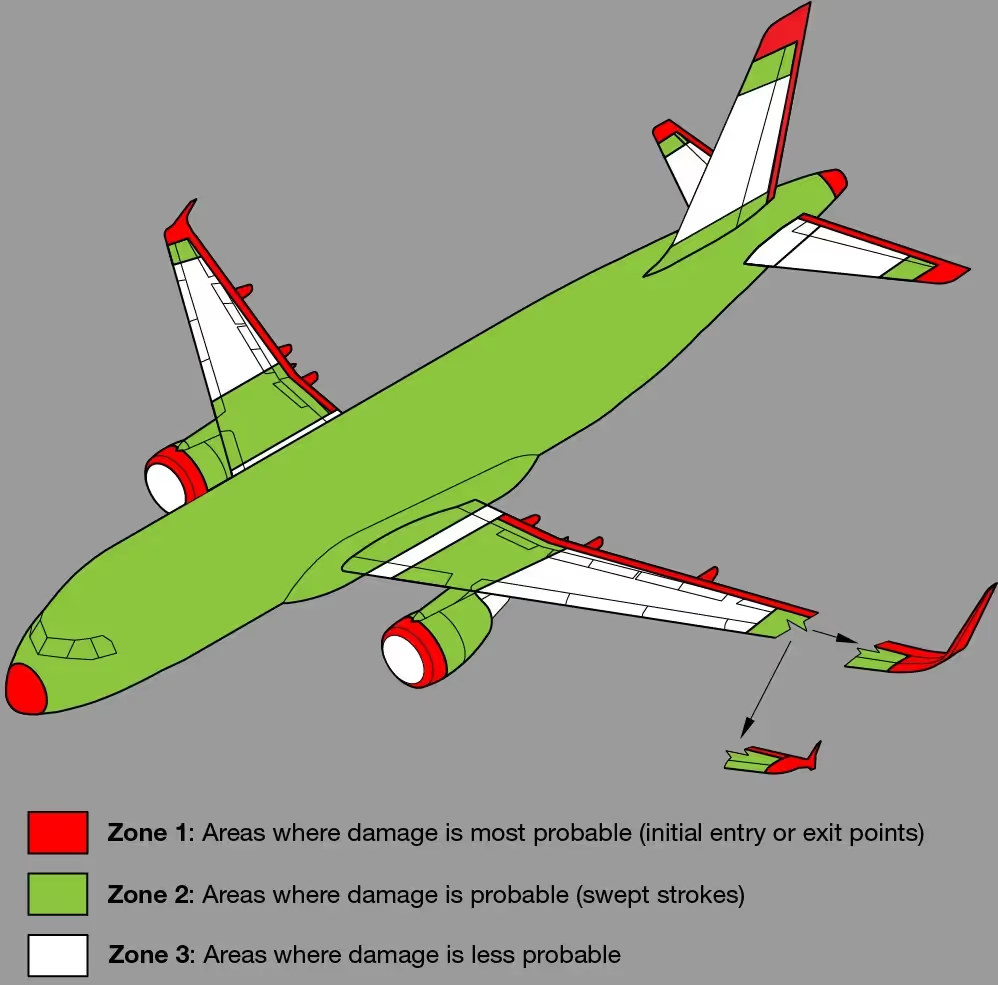
These standards cover everything from waveform testing of system immunity to zonating the aircraft in terms of probability and strike intensity.
Upcoming Developments in Lightning Protection
As the market continues to move towards electric and hybrid-electric propulsion, lightning protection will become even more essential. Power electronics, batteries, and electric motors are themselves sensitive to voltage spikes.
Airplanes such as Eviation's Alice or Airbus' EcoPulse demonstrator will need extremely integrated shielding and transient protection systems. Additionally, autonomous aircraft and eVTOLs will require lightweight yet durable solutions for lightning mitigation.
Concurrently, novel materials such as nano-enhanced composites and conductive polymer coatings are also being researched to enhance conductivity without an appreciable weight gain. These developments aim to enhance lightning resistance while maintaining aerodynamic and structural efficiency.
Conclusion: Predictable, Preventable, and Proven
While lightning strikes are prevalent in air travel, there is minimal threat to flight safety due to years of research, innovative design, and regulatory guidance. Passengers can rest easy knowing that airplanes are built to be resilient to impacts and continue to fly safely, whether they are operating a new composite airliner, such as the A350, or an older aluminum plane, like the 737.
The design landscape for lightning protection will continue to evolve as newer aircraft architectures emerge, seeking to balance the demands of passenger safety, electrical sophistication, and lightness in each turbulent sky ahead.
Featured image: Artturi Jalli/Unsplash




.avif)