
.webp)
.webp)
.webp)
.webp)
DALLAS — Airlines rarely announce how much water they carry, but every drop matters. Excess potable water adds weight and burns fuel, while too little leaves passengers thirsty and crews scrambling.
In reality, airlines have to predict with surprising precision how much water each flight will need, striking a balance between passenger comfort, operational practicality, and cost. Passenger numbers, flight length, aircraft type, turnaround time, and tightly controlled ground-servicing processes all feed into that calculation, which is further shaped by regulatory frameworks such as U.S. and European water-handling rules.
Water Aboard: Who Uses It and How
On any passenger flight, potable water is used throughout: in lavatory sinks and toilets, galley sinks and coffee machines, and for crew use. Modern aircraft have self-contained potable water systems, typically with one or more water tanks beneath the cabin floor. For example, an Airbus A320’s potable water tank holds about 200 L (litres). The water is pressurized (by pumps or bleed air) so it flows to sinks and galley taps.
In service, water is used for handwashing and sanitary needs in lavatories, in galley coffee/tea makers, or in cabin sinks. (Drinking water for passengers is often pre-packaged in bottles due to strict hygiene rules.) A Diehl Hydro report notes that aircraft water systems “supply potable water to the lavatories and galleys of an airplane” and are needed for hot tea and coffee in galleys, while drinking water for passengers is usually bottled. Cabin crew use the same supply for galley service and handwashing, and they typically verify onboard water levels during preflight checks.
In short, passengers and crew draw on the same supply. Water is required for all lavatory sinks (both hot and cold), any galley faucets or coffee makers, and emergency eyewash stations, if installed. On longer flights, especially in dry-cabin air, water consumption can add up: airlines report higher water use on long-haul routes.
Historically, IATA reported an average consumption rate of approximately 0.3 L per passenger per flight hour. Crews sometimes carry a few bottles in crew rest or cockpit as a buffer, but generally, the formal uplift calculation covers total demand. Airlines also usually add a small reserve for crew needs and unexpected delays (see Contingency Planning below).
Estimating Needs: Flight Factors and Calculations
Airlines determine uplift volume during flight planning, using rules in their operations manuals. In broad terms, the formula is: (number of passengers + crew) × (flight hours) × (water consumption rate), plus allowances for overboard waste or cleaning if applicable. An industry guideline (IATA 2011) uses about 0.3 L per passenger per flight hour. For example, a Boeing 737 with 160 passengers on a 5-hour flight would start with roughly 0.3×160×5 ≈ 240 L. Airlines tailor this basic estimate by adding margins or adjustments for factors such as dry routes, hot weather, or full galley service.
Flight duration is critical: longer trips generally require more water but also allow carrying a larger proportion of capacity. For a very short flight (say 1–2 hours), minimum uplift might be limited to lavatory use only, perhaps supplemented by bottled drinks. For an ultra-long-haul (10+ hours), full galley service and additional lavatories drive consumption much higher. Airlines may also use time-of-day factors (for overnight flights where service is lighter, or daytime flights with meals) and seasonal factors (drier summer cabin air can increase lav usage). Advanced carriers now analyze historical water usage data: by tracking actual uplifts vs. arrivals, they refine their consumption models for each route and aircraft type.
Passenger load obviously matters. A full flight naturally needs more water than a half-empty one. If a planned flight has a light passenger count (or many passengers have preboarded with water already), the crew might reduce planned uplift to avoid waste. Conversely, for a special charter or if there’s a high mix of thirsty customers (for example, sports teams), crews might carry extra. In all cases, the airline’s dispatch or load control will generate a load sheet that includes the prescribed weight of potable water. The ground crew then fills the tanks to that volume: if the plan calls for 250 L, the truck will pump until the gauge reads 250 L (or until overflow spills out, indicating full capacity).
Crucially, each flight’s plan includes water as part of the payload. Most flight planning systems allow dispatchers to specify a required water volume; the water’s weight is included in the weight-and-balance calculation, just like fuel and passengers. Airlines’ fuel-planning teams treat the water weight as fixed payload; it is not reduced by choosing alternate tankering, so you cannot “burn off” potable water before landing. This means any excess water carried to the destination is carried aloft unused, which incurs a direct fuel cost (discussed next).
The Cost of Carrying Water: Performance and Fuel
Weight is the enemy of fuel efficiency. Every extra kilogram aboard burns more fuel, whether it’s passengers, luggage, or water. Carrying unnecessary water, therefore, has a measurable penalty. A common rule-of-thumb (endorsed by industry analyses) is that carrying 1 kg of extra weight for one flight hour burns roughly 0.02–0.04 kg of additional fuel. In concrete terms, transporting 1 kg of water for 1 hour might consume about 0.03–0.035 kg of fuel. Multiply over an entire flight: e.g., 500 kg of leftover water on a 9-hour flight burns ~150 kg of extra fuel. That’s enough fuel to carry a dozen extra passengers.
In practice, the fuel burn impact of water depends on the flight profile. On long-range flights, the per-hour penalty is relatively constant, but the absolute fuel burn from water increases over time. On short sectors, the marginal time spent carrying water is lower, but the water still occupies weight (so the percentage fuel increase might be smaller). Either way, airlines aim to minimize the excess water carried. For example, one analysis notes that a single B737 could save around 6,000 kg of fuel per year by reducing the water uplift on each flight by a small amount.
Because of this, airlines strive for precision in planning. Industry consultants advise “monitoring and adjusting” potable water, as with any fuel-efficiency metric. By comparing planned vs. actual water use and correlating it with fuel burn, carriers can tighten their estimates. Finnair reported that by tweaking its standard uplift volumes, it saved 100 tonnes of fuel annually. That illustrates the payoff: a few liters per flight add up over a fleet.
Water weight also factors into takeoff performance and range calculations, just like any payload. On a heavy narrowbody, say a Boeing 737 with ~230 L of water (~230 kg) plus fuel and passengers, the water is a small but non-negligible share of the zero-fuel weight. On a large widebody such as a Boeing 777, the potable tank can hold well over 1,000 L, which is comparable in mass to a full flight’s meal service or hundreds of kilograms of baggage. Pilots must account for this in takeoff weight and center-of-gravity calculations.
However, since water is usually stowed low and aft, it has a modest CG effect – still, it’s included in the aircraft’s weight-and-balance data. (For example, Boeing’s planning documents indicate the 737-800 has about 60 USG of water capacity, roughly 227 L, and a 777-200ER has about 300 USG (~1140 L)) Carrying more weight means a longer takeoff roll, slightly reduced climb rate, and higher cruise drag – reinforcing why airlines avoid “just in case” overloading.
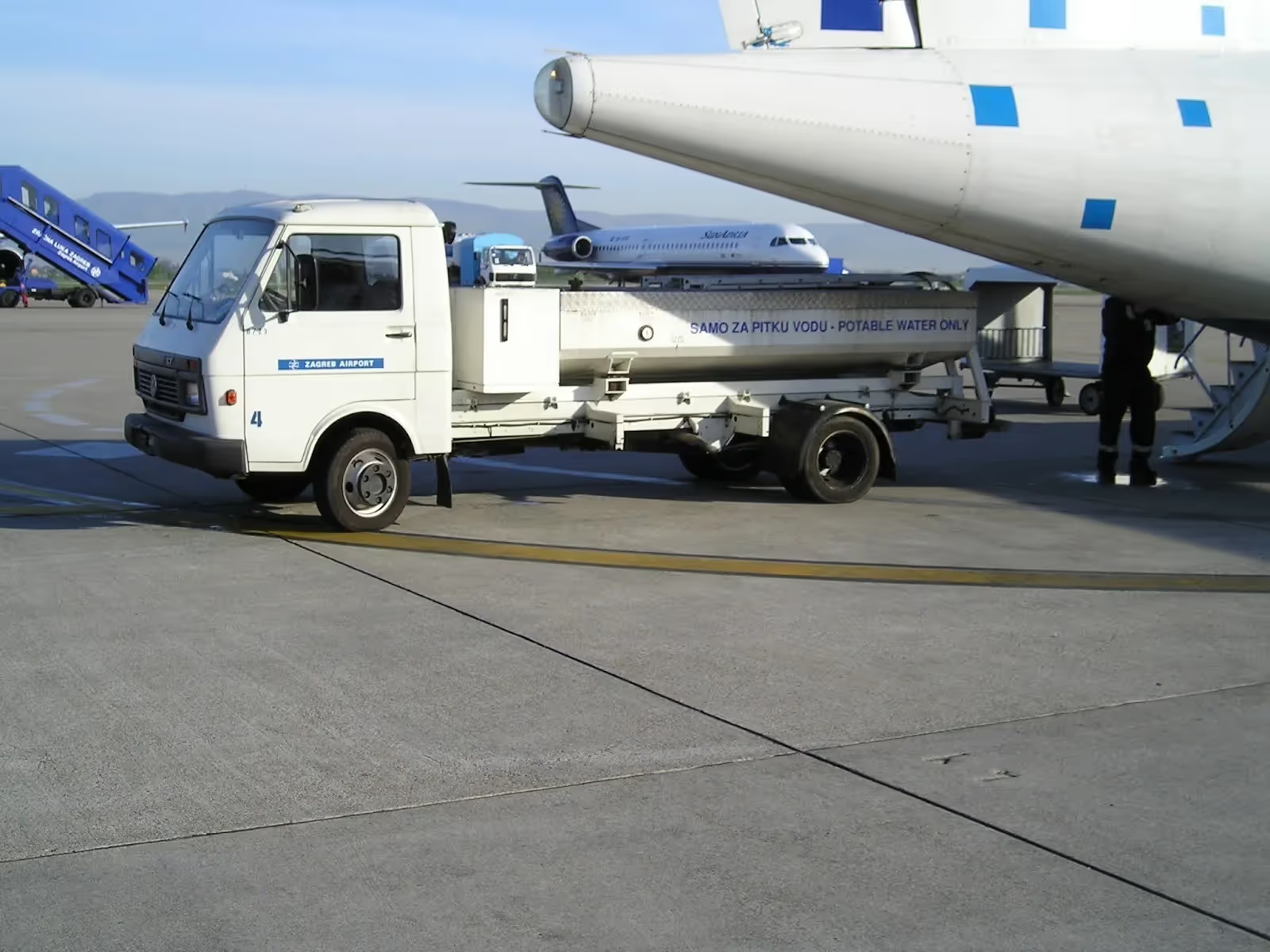
Ground Operations: The Uplift Process
On the tarmac, specialized ground equipment and trained personnel handle the water uplift. The standard procedure is as follows: once the inbound flight has parked and is ready for turnaround, the water service truck (or cart) is driven up to the aircraft’s potable water service panel – usually located near the rear left or right fuselage, depending on the type. The truck is a pressurized tanker marked “Potable Water” (sometimes in the local language). Ground handlers connect a sanitized hose from the truck’s fill valve to the airplane’s fill port. A typical water cart might hold a few hundred liters (for regional jets), while a larger truck holds several thousand liters. For example, some towed carts are on the order of 1,000–3,000 L, and ramp trucks can exceed 5,000 L.
Once connected, the ground crew opens the fill valve. A gauge or quantity indicator on the airplane’s panel shows the water level rising as it flows in. Experienced crews often continue pumping until water begins to overflow from the aircraft’s overflow drain line, which signals that the tank is full. (By design, the overflow outlet is above the tank, and any excess will spill out harmlessly onto the ground.) In other cases, if a precise volume was requested, the team stops when the target literage is reached. The process is done under the supervision of cabin maintenance or ramp staff, who ensure the correct volume is loaded and that connections are leak-free.
The entire system is hygienic and regulated. The truck’s tank is food-grade, and the hoses and couplings are cleaned and inspected regularly. In fact, regulations require that whenever water is boarded at an airport, the supplier must provide water quality certification (e.g., a lab report confirming the absence of coliform bacteria). On many carriers, “cabin maintenance” personnel are responsible for disinfecting the airplane’s water tanks and lines at regular intervals; they will take swab samples from the plumbing and ensure the A/C’s water meets WHO/FDA standards. The ground crews themselves wear protective gear (gloves, etc.) when handling potable water to avoid contamination.
Industry guidelines also standardize Ground operations. IATA’s updated Airport Handling Manual (AHM) includes a chapter on potable water servicing. For example, AHM 440 (Aircraft Handling & Loading) specifies how water vehicles and lavatory service trucks should be positioned during servicing. The idea is to keep water trucks away from sewage trucks for safety. AHM 440 (in its 2025/2026 editions) is explicitly aligned with WHO and international health rules: the potable water servicing section is “aligned with WHO, IHR (2005)” standards. In Europe, EASA’s draft ground-handling regulation (GH.OPS) similarly demands that ground service providers follow the aircraft operator’s own procedures for water servicing and maintain the proper safety and training standards. (Also read: Explained: The Untold Story of Aircraft Lavatories)
Once filled, the ground crew closes the valves, detaches the hose, and, if needed, rinses the panel hardware. If overpressure or a drip occurs, the drainage masts under the fuselage safely expel it. The tanks are pressurized and sealed until cabin use. During boarding, flight attendants will verify on the Flight Attendant Panel that the water quantity is as expected and that the aircraft is ready to depart.
Contingency and Redundancy Planning
Airlines build in a modest “buffer” when planning water, though this is often much smaller than the fuel reserve. A margin of 5–10% is common and is designed to cover slight overconsumption or brief delays. For example, if a flight may encounter a long taxi or an unexpected departure delay, the dispatcher may request enough water for the planned flight duration plus the additional taxi/hold time. Crew briefing materials often remind pilots to check the water gauge if a flight is held. In practice, however, once the aircraft has left the gate, nearly all remaining water is either used for passengers or given to the next flight: carriers rarely “tank” huge contingencies in water weight because of the fuel cost penalty.
If a scheduled water service is missed (e.g., the ground truck is unavailable), airlines usually cannot depart without potable water. FAA and EASA rules require that an airplane must have a usable toilet and wash water for all passengers on board for the planned duration. In extreme cases, crews would rely on bottled water to meet any shortfall. (In fact, under U.S. regulations, if an aircraft is held on the tarmac for more than two hours, the airline must provide adequate drinking water to passengers. While that rule is about passenger comfort, it indirectly pressures carriers to ensure water is available onboard in everyday operations.)
Diversions or unexpected reroutes can also stress the water plan. Long over-water diversions or returns may require more lav usage than planned. Airlines typically mitigate this by carrying a few extra bottles and reminding crew to conserve if needed. At outstations, ramp agents are trained to service aircraft that divert to an alternate without permanent ground support. If necessary, a remote fueling truck can temporarily supply potable water to enable a safe landing. In reality, these situations are rare, but companies do include “water availability” as one factor when selecting alternates or diversion airports. Overall, redundancy in potable water planning means topping up tanks whenever possible and maintaining procedural backups (e.g., extra bottled water, rapid-refill protocols) so that a missed service is corrected before pushback.
Regulations and Regional Differences
Ensuring safe drinking water aboard aircraft involves both aviation safety regulations and public health laws, and these vary by region. In the U.S., a key reference is the EPA’s Aircraft Drinking Water Rule (ADWR). This rule (stemming from the Safe Drinking Water Act) requires air carriers to sample and disinfect their onboard water periodically. Under ADWR, the EPA and FAA jointly oversee water quality: airlines must maintain their water at EPA drinking standards and submit test results. The FAA’s role is to enforce operational compliance (through inspections and possible actions if carriers fail to test or disinfect). Thus, a U.S. airline must not only plan water volumes but also log its water treatment and testing as part of its maintenance program.
In Europe, there is no single EU-wide “aircraft water” law analogous to ADWR. Instead, the quality of potable water and servicing standards is governed by a combination of IATA guidelines, ICAO provisions, and national public health regulations. Notably, IATA’s ground-handling standards (AHM 440) explicitly reference WHO guidelines on water safety. EU carriers often follow IATA’s Airport Handling Manual or the International Ground Operations Manual (IGOM) for water servicing practices. Meanwhile, EASA oversight is implicit: for instance, EASA’s Part-145 maintenance rules require airlines to maintain cabin systems (including water tanks) properly, and inspectors will verify that potable water is handled in accordance with accepted standards. The new EASA ground-handling regulation (GH.OPS) reinforces this by mandating that handling companies follow the operator’s water-service procedures.
One slight regional nuance: some countries have their own agencies for water safety on aircraft. For example, in the U.S., the FDA also regulates the water used in food preparation on planes. But fundamentally, the U.S. vs. EU difference boils down to enforcement: U.S. airlines operate under explicit EPA/FAA rules on water quality, while EU carriers rely on industry standards. Nevertheless, both systems aim for the same result – no drinking-water hazards and enough supply for every flight.
Looking Ahead
Airlines are only now beginning to squeeze further efficiencies out of water planning. On the technology side, some carriers are deploying onboard sensors to measure actual water consumption. Flight data recorders or digital flow meters can tell operations centers exactly how many liters were used on each flight. This data feeds back into planning tools: for instance, if it turns out flights from hot climates consume 20% more water, the following dispatch cycle will factor that in.
Another trend is integrating potable-water management into bigger fuel-efficiency programs. As one operations researcher put it: “If your goal is to cut fuel, you can’t ignore the weight of water”. Some airlines now include water uplift margins in their fuel burn models, giving it the same scrutiny as payload or fuel reserves. We may see new software modules in dispatch systems that automatically adjust water orders based on historical data and in-flight updates.
Environmental concerns also add incentive. Carrying unnecessary weight conflicts with airlines’ carbon-reduction goals. As manufacturers design new aircraft, lighter water tanks and more intelligent systems are emerging. Future lavatory systems might recycle a tiny fraction of the water used or generate pressurized water more efficiently, reducing overall water use. Even airports are installing better water-testing and faster mobile rigs to top up planes just-in-time with higher confidence, which could allow airlines to run with slimmer buffers.
In the years ahead, health regulations and sustainability goals will continue to reshape how airlines plan for water. For now, it’s a quiet reminder of airline efficiency: saving just a few ounces on each flight can add up to tons of fuel, and CO₂ spared across a global fleet.
Stay tuned to Airways and follow us on LinkedIn and Instagram for the latest updates.
Featured image: Adrian Nowakowski/Airways



.avif)
