
.webp)


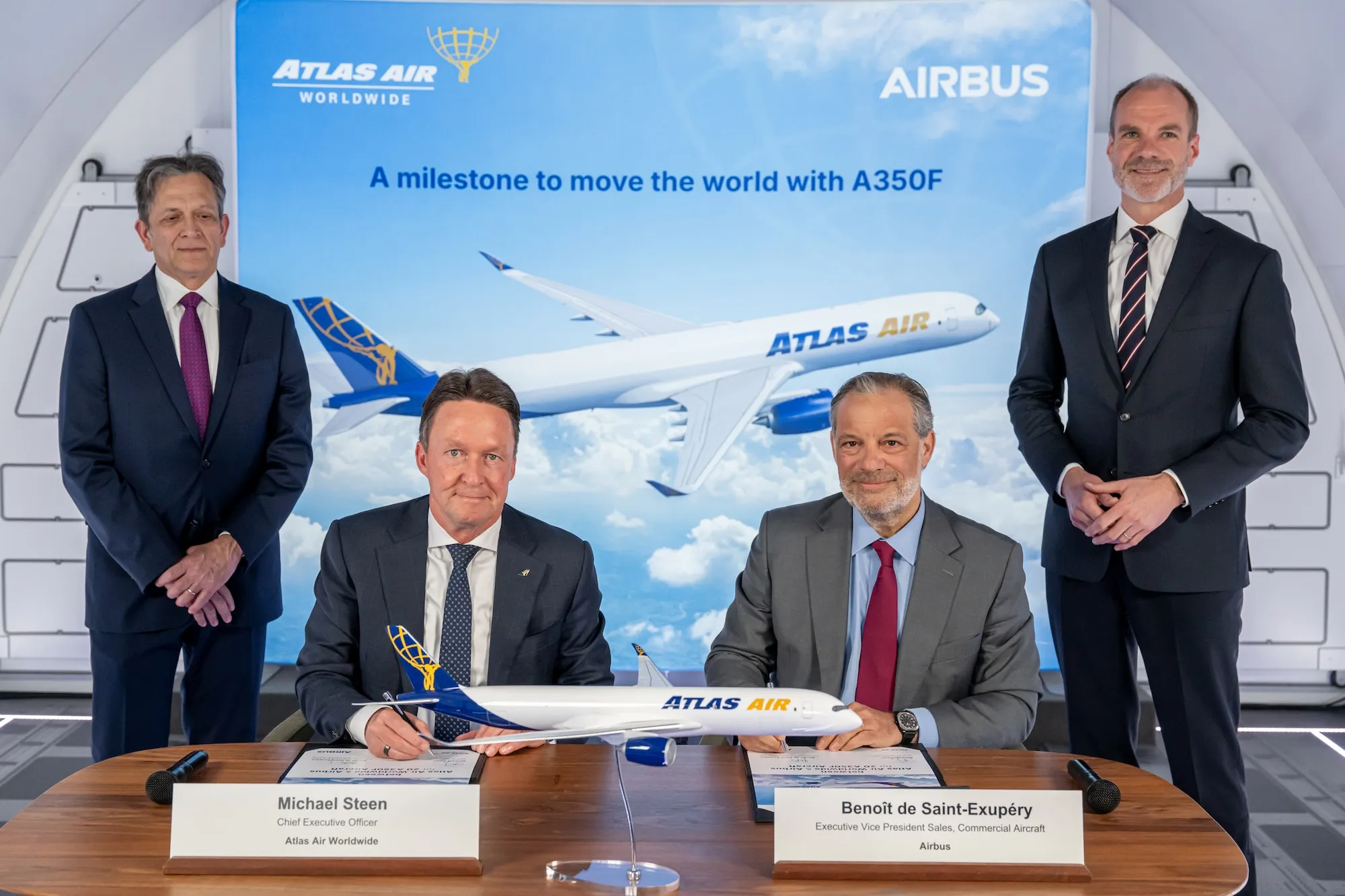
TOULOUSE — Atlas Air (5Y) today announced a firm order for 20 Airbus A350F aircraft, with options for an additional 20.
The deal, the largest single order placed by the carrier in its history, represents a brand new customer for the type and makes Atlas its largest customer globally. It’s also Atlas Air’s very first order for Airbus jets.
The new order brings the A350F’s firm backlog up to 101 units (adding to Airbus’ published order and delivery numbers for February 2026), with today’s order marking the first order from a North American company. Deliveries are slated to begin in 2029 and continue through 2034.
In a press release, the airline says that the new jets will be powered by Rolls-Royce’s XWB-97 turbofans and will complement the carrier’s existing fleet of Boeing 747s, 767s, and 777s. Despite operating an all-Boeing fleet today, Atlas Air has not committed to the next-generation 777-8F, the A350F’s closest competitor, despite already operating the 777F.
“We are proud to become the largest customer for the Airbus A350F, securing early delivery positions for this next-generation widebody freighter platform,” said the CEO of Atlas Air Worldwide, Michael Steen.
“This order reflects our commitment to maintaining the industry’s most modern and fuel-efficient widebody freighter fleet to best serve existing and new customers worldwide. The A350F is a highly capable, reliable platform, with incremental payload and range benefits, and a strong sustainability profile. We are pleased to add Airbus and Rolls-Royce to our supplier base of leading aircraft and engine manufacturers, offering us optionality and supporting our global operations and continued growth.”
CEO of Commercial Aircraft at Airbus, Lars Wagner, also stated that: “We are excited to welcome Atlas Air Worldwide, a global leader of the air cargo industry, to the Airbus family. Atlas Air’s selection of the latest generation A350F - the first in the US - represents a pivotal moment, cementing the A350F’s position as the preferred true all-new-generation freighter for the world’s most demanding cargo operators. We very much look forward to seeing it flying in Atlas’ colours."
Atlas Air currently operates an all-Boeing fleet, including 747s and 767s in both freighter and passenger configurations, as well as 777Fs, one of which is still on the way from Boeing. Many of these aircraft are on contracts with companies around the world.
Delays on both sides of the manufactuing pond
Neither the A350F nor the 777-8F is a stranger to delays. Both under-development large freighters have been repeatedly delayed since their launches in 2021 and 2022, respectively.
The Airbus widebody cargo jet was originally slated to fly in 2025 and enter service with airlines in 2026; however, as we approach Q2 of 2026, the prototype type aircraft has not yet been completed or rolled out.
Airbus now says the first A350F will fly in Q3 this year, with first deliveries beginning in the second half of 2027, citing supply chain constraints related to the centre fuselage section supplied by Spirit AeroSystems.
But things on the Boeing side tell a different story.
The Boeing 777X program has been a disaster of deadlines for the American manufacturer, with the 777-8F caught in the tides of the 777-9’s slow, perpetually delayed crawl towards certification.
The Seattle-made freighter was launched under an order from Qatar Airways (QR) in January 2022, with delivery expected to begin in 2027. Officially, that date has since been pushed to 2028, however production is progressing behind the scenes in Everett with the first holes drilled in the first wing in July 2025.
Boeing continues its push toward 777-9 certification and entry into service, now slated for 2027, down from its original 2019 target. 2026 marks six years since flight testing began, the longest flight test and certification campaign since Concorde.
Quick note: Airbus on Monday released its February 2026 orders and deliveries report.
In February 2026, Airbus delivered 35 aircraft across its single-aisle and widebody families. The A321neo remained the backbone of production, accounting for 60% of total deliveries.
Delivery breakdown:
- 8 A220-300s
- 4 A320neos
- 21 A321neos
- 1 A350-900
- 1 A350-1000
That total was down from February 2025, when Airbus delivered 40 aircraft.
Featured image: Airbus




.webp)