FAA Ends Visual Separation for Airplane-Helicopter Conflicts Near Busy Airports


.webp)
.webp)
.webp)
.webp)
WASHINGTON, D.C. — The FAA will discontinue visual separation for airplane-helicopter conflicts in high-traffic terminal airspace. Controllers must now use radar separation when helicopters intersect airport arrival and departure flows.
In a March 18 announcement, the FAA said its latest General Notice (GENOT) “suspends visual separation” in Class B, Class C, and Terminal Radar Service Area (TRSA) environments where helicopter routes cross fixed-wing traffic paths. Controllers will instead use radar to maintain defined lateral or vertical separation minima. (Federal Aviation Administration)
This change significantly affects how towers and TRACONs manage mixed traffic. Visual separation relies on controllers or pilots confirming they see the other aircraft and can “maintain separation.”
In dense terminal environments, especially with converging helicopter routes, the FAA’s review found that “see-and-avoid” and visual techniques have been overused and are not sufficient as the primary mitigation.
What triggered the move
The FAA described the change as the result of a year-long safety review following the January 2025 midair collision near Washington Reagan National (DCA) between an American Airlines (AA) regional jet and an Army helicopter, which killed 67 people. The review also considered other recent close calls involving helicopters and commercial aircraft.
A recent incident involved an AA flight near San Antonio (SAT), where a helicopter crossed the aircraft’s approach path. This prompted increased scrutiny of helicopter transitions through arrival and departure corridors.
The FAA stated the rule change applies to Class B, Class C, and TRSA airspace, covering more than 150 of the busiest U.S. airports where helicopter and airline traffic often intersect.
Affected facilities will implement procedural updates, including letters of agreement, helicopter transition routing, altitude blocks, and controller techniques, as radar separation becomes mandatory where paths intersect. While this may reduce flexibility in some cases, it aims to eliminate ambiguity in the highest-risk mixed-traffic segments.
Analysis of the decision
The FAA’s March 18 move is best read as one layer in a broader post-DCA safety package:
- Shift away from “see-and-avoid” as the primary mitigator in dense terminal airspace: FAA says its year-long review found an overreliance on pilot visual separation, so controllers must now use radar separation at defined lateral/vertical minima at 150+ airports.
- Targeted fixes that started at DCA first: DOT lists earlier steps including amending local procedures to eliminate visual separation within 5 miles of DCA, closing a key helicopter route segment, and revising military agreements (including ADS-B Out requirements) — i.e., the FAA is standardizing a DCA-type mitigation approach nationwide.
- NTSB framing: NTSB’s report on the Potomac/DCA midair collision is part of the evidentiary backbone behind the shift toward more deterministic separation standards in mixed rotorcraft/fixed-wing corridors.
Are comparable procedures under review outside the U.S.?
- Europe already tends to be more conservative about visual separation at night/complex terminal environments, and separation standards are embedded in national ANSP procedures under ICAO-aligned frameworks—so the “gap” the FAA is closing may be smaller in some European contexts. (This is an industry-common observation, but it’s not the same as a documented EASA order — so phrase it as “procedure differences exist,” not “Europe bans it.”)
- International follow-through typically happens via: national ANSP safety cases, ICAO guidance updates, and regional safety plans — not always via a single headline policy change.
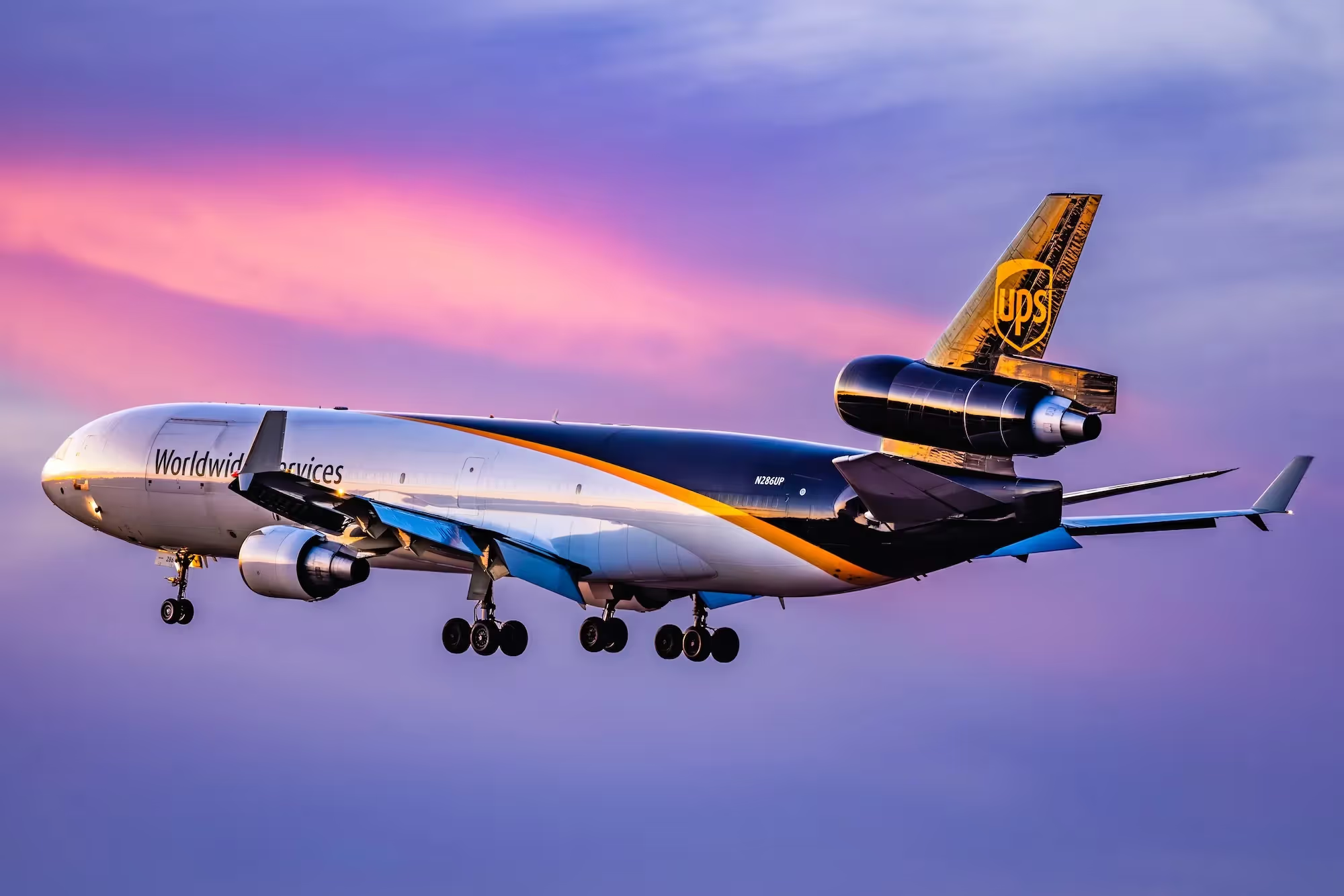
Featured image: Michael Rodeback/Airways



.avif)