
.webp)

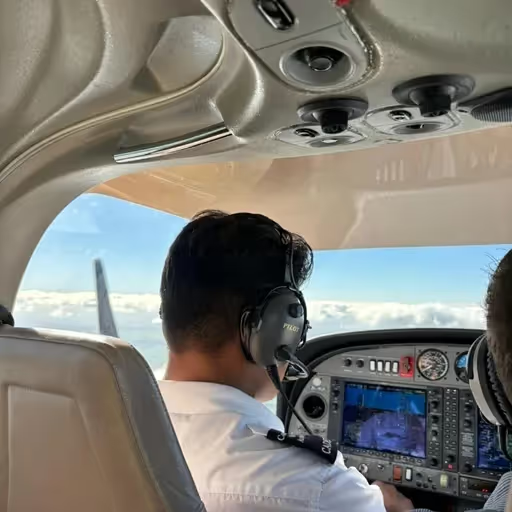
DALLAS — When an airliner turns off its engines at the gate or ramp, the flight deck doesn’t simply go dark and stay that way.
In the minutes, hours, or even days before the next crew returns, a range of people, from cleaning staff to maintenance technicians, swarm the cockpit to secure, clean, power down, and prepare the aircraft.
Let’s dive into what really happens after the pilots exit the flight deck!
Post-Flight Shutdown, Short-Turnaround Checks
Immediately after touchdown and taxi, the flight crew runs the after-landing and shutdown checklists for their aircraft. For example, a typical Airbus A320 checklist calls for setting the parking brake, placing the thrust levers at idle, and “calling for ground contact” (i.e., plugging in the GPU) once at the gate.
The pilots then secure engines and systems: engine master switches off, wing anti-ice off, passenger signs off, and cockpit exterior lighting off. Modern airliners are highly automated, so many systems shut down automatically, but pilots carefully follow the checklist to ensure nothing important is left running.
Once on the ground, crews will extinguish the navigation and strobe lights (used in flight), fuel pumps, and, sometimes, the APU bleed air system. In Boeing 737 jetliners, the pilots will also switch off the IRS (Inertial Reference System) gyros and take the aircraft’s standby power sources offline.
An Airbus crew performs the equivalent by turning off the ADIRS (Air Data Inertial Reference System) units and avionics buses after engines are cooled. At this point, the cabin crew has opened the cockpit door for the cabin clean and boarding, so the pilots turn off the flight directors (autopilot guidance displays) and ensure the cockpit door is unlocked for service staff.
Nearly all aircraft now require external ground power or the APU to supply the electrical system during turnarounds. In practice, once the engines are shut down, the crew connects the jet to a GPU (ground power unit) or starts the APU, if needed, to keep the lights, avionics, and air conditioning running for cleaning and boarding. For instance, the Boeing 787’s “Engine Shutdown” procedure calls for “EXTERNAL POWER ON” after the engines are cut off, then turns things off like taxi lights and fuel pumps.
Only after ground power is assured do the pilots open cockpit doors and begin shutting non-essential systems. The final steps in the Boeing 787 checklist are to turn off pressurization, packs, pumps, and interior lights – and finally the battery switch itself – making the aircraft electrically “dead” except for ground power. Likewise, the A320 parking checklist ends with “APU off” and “batteries off” once the GPU is driving the aircraft.
In short turnarounds (usually 30–90 minutes), the pilots’ post-flight actions end with the cockpit in a quiescent state: engines off, most electrics off, ground power supplying only what’s needed. However, many crews will leave some systems live if the turnaround is rapid.
For example, some carriers run the APU or avionics, so cabin systems (lights, cleaning equipment) keep working without interruption. In practice, these decisions vary by airline and airport, but safety regulations require that no critical systems remain unattended. Crews must always complete the official shutdown checklist in their manual before leaving, whether the next flight departs soon or the next morning.
Cockpit Cleaning, Hygiene
Meanwhile, cleaning crews follow their own checklist for the cockpit. Industry guidelines – for example, the IATA ground‐handling contract (SGHA) – specify interior cleaning tasks separately for the flight deck and cabin. If the carrier requests it, cleaners will wipe down the cockpit under a supervisor’s watch. Typical tasks include vacuuming floors, dusting surfaces, wiping the window panes, and emptying waste bins.
A pandemic-era IATA/WHO guidance even lays out detailed “turnaround” and “layover” cleaning tasks: it lists disinfecting pilot and copilot seats (armrests and belts), steering tiller and side consoles, instrument panels, overhead panels and handles, and even headsets and cockpit windows. These cleaning tasks are usually performed using approved cleaners applied with a cloth; spraying chemicals onto sensitive panels or instruments is prohibited to avoid damage.
Cleaners do not move or adjust any switches, knobs, or displays. In fact, it is standard practice for the janitorial crew not to clean instrument panels and flight controls. Any accidental triggers must be reported. The World Health Organization’s aviation hygiene guide (via ICAO) and IATA both recommend that an authorized company representative must supervise any entry of cleaning staff into the flight deck.
In practice, this means a lead agent, flight attendant, or technician stands by. Buckets and heavy equipment are kept entirely out of the cockpit. The cabin crew or cleaners will vacuum around the pilots’ seats and wipe down visible surfaces – but a diligent inspector will verify that nothing is moved or wet. The frequency is typically once per day, or every few flights, and more thorough disinfection occurs overnight or during extended parking.
Maintenance Checks, Avionics Duties
After the cleanup, the aircraft is handed to maintenance. At hub locations, a technician often boards to review the aircraft logbook (maintenance log) completed by the pilots. Any write-ups or faults recorded by the crew, including a minor amber on the status display, must be addressed or deferred in accordance with company policy. If no faults exist, ground staff may still perform routine visual inspections.
For example, some airlines require a quick post-flight walk-around at remote stations: this is a cursory check for leaks or damage (fluids dripping or a dent, etc.) so that any anomaly can be logged and fixed overnight rather than delaying the next flight. Maintenance may top off fluids (oil, water, hydraulic fluid) if low, replace oxygen cylinders, or note any component wear.
Avionics technicians often use the layover time to download and clear fault messages. Modern airliners record flight data and fault histories in central data units. For instance, the Boeing 787’s Central Fault Display Interface Unit compiles a Post-Flight Report (PFR) automatically when engines shut down. Maintenance computers then upload this report for review. If a non-critical fault is found, a mechanic will reset the associated panel light or circuit breaker. (Pilot regulations generally forbid resetting tripped breakers more than once, as repeated resets can cause fires.)
Still, a one-time reset by maintenance is common for issues such as a single autopilot warning or an unnecessary alert. Technicians also check that all cockpit switches have been returned to the normal (OFF) positions as per the shutdown checklist. If anything was left on, they set it back to the correct state; for example, if the maintenance computer was used, they turned it off again so it wouldn’t drain the battery.
In summary, while cleaning crews handle the cockpit’s physical surfaces, ground engineers tackle its systems. The process is often documented on aircraft maintenance record forms: inspections are signed off, discrepancies are noted, and any fix-or-fly deferred items are filed. This behind-the-scenes work is invisible to passengers but essential to ensure the flight deck is fully ready for the next crew.
Aircraft Securing, Long-Term Parking
For an overnight layover, the shutdown goes a step further. Many of the same steps (batteries off, packing up checklists, etc.) are repeated, but the aircraft may be left for hours. In mild weather, pilots might leave the primary batteries off to save power, since a GPU will be plugged in for cabin service. Airbus manuals typically state “Batteries – as required” (usually OFF if GPU is on), and Boeing procedures likewise switch off standby power, and the battery once external power is confirmed.
If the aircraft is parked for extended periods (weeks or longer), more steps are added. Airlines will park in the shade or use cockpit blinds to protect against the sun, remove or secure any perishable items (snacks or paperwork), and, if high winds are expected, install gust locks or control locks. (Large jets generally don’t need routine gust locks due to hydraulic damping, but in storage, they may apply locks or tie-downs to control surfaces if weather demands.) Wheels are chocked and pitot covers placed. The cockpit is carefully double-checked: personal items are removed, documents are filed, and the final positions of the cockpit seats and controls are noted.
Upon reactivation for a long layover, the reverse process occurs. Ground power is connected, and all switches are systematically turned on again. The engine and APU master switches stay off until needed. Still, the crew will realign inertial systems, power on avionics, test lights and warnings, and essentially walk through the “preflight” flow (with external power) before starting engines.
In practice, many airlines actually leave cabin power on during the layover so that toilets can flush and lighting works – thus the cockpit may never go completely “dead” between flights. Still, whenever the pilots return, they personally verify that all flight deck systems boot up properly, running a mini-acceptance test before taxi.
Cockpit Security, Access Control
Security rules heavily influence what happens after pilots disembark. By regulation, the cockpit door must remain locked or monitored whenever the crew is away. On large passenger jets, international rules (ICAO Annex 6) mandate a hardened, lockable cockpit door with two-way access capability. In practice, the captain typically conducts a final security sweep before departure. This means inspecting the cockpit for any foreign objects or tampering (no unauthorized items left behind) and ensuring that any forms or charts containing sensitive information are stowed or removed.
Ground personnel are rarely allowed to enter the flight deck unaccompanied. If a mechanic or cleaning agent must access the cockpit (e.g., to vacuum under seats or refill emergency checklists), airline policy generally requires that a flight attendant or pilot remain onboard as an escort. Some carriers even use tamper-evident cockpit seals or require the co-pilot to log door lock/unlock times.
These procedures prevent any security breach and ensure the cockpit’s integrity from post-flight to pre-flight. In many airlines, the outgoing captain will also sign a form certifying that the aircraft was left secure, and the incoming crew will double-check the cockpit door status as part of their preflight routine.
One practical example of strict access control: airlines advise pilots to keep the cockpit window cover locked when leaving for the night, and to anchor any onboard cockpit equipment (e.g., flight manuals, pens) to the floor stowage. Some operations instruct pilots to place electronic devices in view to show that the cockpit is empty.
While these measures sound extreme, they are part of a broader security culture. Any evidence of unauthorized cockpit entry would trigger immediate maintenance and may result in a delay while security personnel investigate.
Human Factors: Communication with Ground Crews
Miscommunication between the flight crew and ground teams can gum up even the simplest turnaround. In a well-run operation, the pilots depart the cockpit only after confirming with the ground agent that everything for the next flight is on track (GPU is connected, stairs will be pulled away, cargo doors closed, etc.).
In practice, confusion can happen. For example, if ramp staff assume the pilots have cut power but the crew meant to leave the APU on for cooling, an engine cowling might be closed too soon. Or if the crew signs out and leaves with the passengers while the cleaning crew is halfway through cockpit work, the cleaners must quickly extricate themselves.
Airlines mitigate this with checklists and briefings. Typically, the captain or purser announces “last call,” ensures the cabin is empty, and then confirms with ground personnel that servicing (fueling, catering, cleaning) is complete or in progress. The departing cockpit crew will also hand over the maintenance log to the mechanics, who then run their tasks.
Yet there have been cases where poor communication caused delays. For instance, a maintenance swap between flights might be botched if the arriving crew forgets to report an unresolved cockpit defect, leading to a surprise when the replacement pilots notice a blinking light.
Good ground–air communication practices include radio calls (“FOBFS”, final out-of-boarding full-stop check) and use of visual signals on service vehicles. Human factors experts note that shared mental models and check-backs (“Did you plug in the GPU?” “Yes, GPU on 28 volts steady”) are crucial. Inattention or assumptions can have real consequences: an apparently minor switch left in the wrong position can prevent the next cockpit crew from even powering up the aircraft.
Airbus vs. Boeing Procedural Differences
Most major airlines operate fleets of both Airbus and Boeing aircraft, and each manufacturer has its own terminology and cockpit logic. However, the outcomes of shutdown and startup routines are similar. The differences that affect post-flight handling include naming and the sequence of specific items:
- Inertial navigation systems: Boeing jets (like the 737, 777, 787) have “IRS” gyros, whereas Airbus models use “ADIRU” or ADIRUs. The shutdown checklists reflect this by instructing crews to turn off IRS on Boeing and ADIRSon Airbus. In either case, the purpose is the same: to prevent battery drain while the aircraft is on the ground.
- Auxiliary Power: On both types, the APU is often left running until ground power is established. But some Boeing checklists explicitly say “external power on” before “APU off”, while Airbus checklists may simply say “APU off” once engines and necessary systems are shut down. The procedure timing may vary slightly, but the principle (don’t shut off all power before spooling up the GPU) is universal.
- Overhead Panel vs. Center Console: The control layout differs (e.g., anti-ice is handled via overhead levers on Boeing and via a center pedestal on Airbus), but both types require turning off wing/radome anti-ice and packs at shutdown. The checklists read differently, but ground crews trained on one type quickly adapt to the other’s shutdown cues.
- Flight Deck Items: An Airbus A320 cockpit has “no smoking” and “seat belt” light switches prominently at the center; the Boeing panel might be overhead. Cleaning crews must thus follow slightly different maps. Nonetheless, guidance such as “turn off passenger signs” appears on both the Airbus and Boeing lists.
In brief, the underlying actions — set parking brake, cut off fuel, power down instruments, connect ground power, then secure the aircraft — do not differ by manufacturer. The manuals and quick-reference handbooks just use different switch names and orders. Airlines standardize their SOPs to ensure a smooth transition between aircraft types for crews.
Flight Deck Irregularities, Delays
Even a minor issue on the flight deck can have an outsized impact on flight schedules. A foul-weather crew might refuse to fly with a cockpit light bulb burned out, or an inoperative audio headset jack, even if the rest of the jet is airworthy. Airlines typically list these items in their Minimum Equipment Lists (MEL), and a defect on the MEL may be deferred, but minor snags still require maintenance attention. For example, one forum post recalls a Boeing 747 being delayed seven hours to replace the manual release mechanism for the captain’s seat – an item one might think wouldn’t ground a 747, yet policy required it. (In short, any crew item on the maintenance log must be fixed or officially deferred per regulations, even if it seems “minor.”)
On the flip side, ground staff can also inadvertently cause delays. A mis-set circuit breaker left by an impatient technician can lock out a cockpit system, so the captain finds a disabled display and must have maintenance reset it before departure. Or a miscommunication might cause the pack switch to remain OFF, leaving the cockpit unpressurized during a boarding delay.
These human-factor snafus underscore why multiple checklists and sign-offs exist: ideally, the arriving captain thoroughly checks the flight deck, and the departing crew verifies all external servicing tasks. When these protocols break down, flights can sit on the ground for precious hours.
Conclusion
From the moment the engines stop and the parking brake sets, the flight deck enters a hidden world of activity. Specialists sweep and sanitize the cockpit, mechanics hunt down quirks in the computers, and the aircraft is gradually powered down or re-energized, depending on its next mission.
Throughout, airline standards, regulatory mandates, and common sense shape each action. Daily checklists (e.g., for the A320 and 737) drive the power-off sequence, while hygiene guidelines (WHO/IATA) specify what cleaning crews may touch.
Security rules ensure the cockpit remains locked and accounted for when unattended. Communication between pilots and ground crews keeps the process on track, though lapses can cause inconvenient delays. Even though procedures are broadly similar worldwide, an airline’s culture and the aircraft’s make/model can color the details.
In the end, the flight deck’s day does not end with the pilots. It quietly becomes someone else’s workplace: housekeeping, maintenance, and security all converge to reset, inspect, and prepare it. Only when the next crew arrives, performs their preflight checks, and powers back up all systems does the cockpit spring to life again for another journey.
Stay tuned to Airways and follow us on LinkedIn and Instagram for the latest updates.
Featured image: Dominik Csordás/Airways


.webp)