

.webp)

DALLAS — Spirit Airlines (NK) faces a high-stakes debtor‑in‑possession (DIP) financing milestone today, December 13, 2025. According to The Air Current, some rivals believe the DIP could trigger an abrupt shutdown. Still, the Dania Beach-based airline is publicly insisting “business as usual” and says talks with lenders remain “productive,” adding that “there is no truth to any rumors that we are preparing to cease operations.”
The story reads with the tension between competitors quietly planning for NK's failure and its effort to project confidence as it works through its second Chapter 11 in a year.
What’s Happening Today
Spirit’s restructuring hinges on a DIP financing package of up to roughly US$475 million, arranged with existing bondholders and approved by the bankruptcy court in October, designed to keep operations running through Chapter 11. According to airlinegeeks.com, today’s milestone appears to govern NK’s ability to draw an additional US$100 million under that facility, and several airline executives doubt the carrier will meet the conditions for that next tranche.
If NK cannot access the cash, rivals and some creditors see an elevated risk that the carrier moves from an operating reorganization to a rapid shutdown, rather than a slower, “orderly wind‑down.” The timing is especially fraught because Spirit has more than 400 flights scheduled today and over 3,000 more in the following week, placing tens of thousands of peak‑season travelers at risk of disruption.
How Competitors are Positioning
TAC's John Ostrower and Edward Russell report that at least two large U.S. airlines have prepared contingency schedules to immediately backfill NK flying if the ULCC collapses as early as today, including rescue fares to recover stranded passengers on overlapping routes. Other carriers with smaller fleets or limited overlap are monitoring the bankruptcy milestone but see themselves as less able to move quickly if a shutdown comes, either for fleet or network reasons.
The fact is that conversations abound regarding who will get NK’s network and assets. All the while, NK added capacity in its core markets while watching its finances deteriorate through 2025. A second Chapter 11 filing in August, following the collapse of the JetBlue (B6) merger and a prior 2024 restructuring, left NK shrinking its fleet, cutting destinations, and furloughing hundreds of pilots and cabin crew to stem cash burn.
Hear our recent Airways Podcast episode with Hooman Yazhari, partner in Michelman & Robinson's restructuring and corporate practice group, as we discuss the challenges faced by NK and ULCCs.
Spirit’s Public Posture, Recent Concessions
Spirit’s public line negates any and all shutdown rumors and that operations are normal, even as it acknowledges intensive work with DIP financiers and other stakeholders to “support the financial needs and future of the business.”
Management cites ratified agreements with pilots and flight attendants that include temporary pay and benefit concessions, projected to save at least US$100 million annually, as evidence that the restructuring plan is gaining traction.
Court‑approved deals with its largest lessor, AerCap, and the DIP facility itself have been framed by NK as “significant progress” toward a leaner, more sustainable operation with a smaller fleet and footprint. But bondholder and analyst commentary characterizes the plan as a radical contraction, and the company has already warned that existing equity holders are not expected to recover value under the current Chapter 11 plan.
Stakes for the ULCC model and customers
Spirit’s fate has become a broader referendum on the U.S. ultra‑low‑cost model, which has been squeezed by soft leisure demand, heavy domestic capacity, and intensifying fare competition from larger network carriers. United Airlines’ (UA) CEO has already publicly argued that NK is headed for collapse and questioned the viability of deep‑discount airlines that cannot generate enough ancillary revenue to offset rising costs.
For passengers, the immediate risk is disruption: if NK were to shut down abruptly over a peak travel weekend, rival carriers’ rescue fares and backfill capacity would determine how painful the transition becomes in affected markets. For regulators and policymakers, the disappearance or drastic shrinking of a major ULCC would raise fresh questions about airfares, competition, and whether a more consolidated market leaves fewer truly low‑fare options for price‑sensitive travelers.
My Last Spirit Flight?
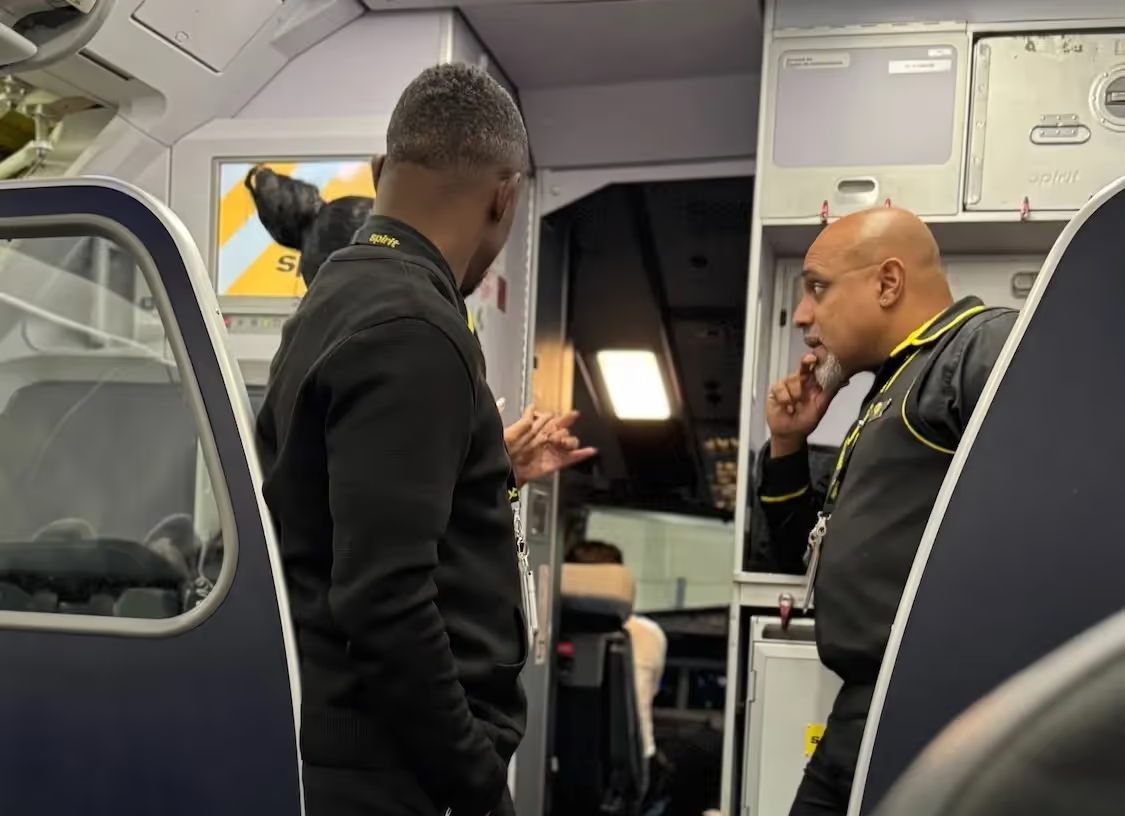
Last Sunday, my wife and I flew NK with our beloved pet on short notice from Fort Lauderdale (FLL) to Tampa (TPA). I have to commend the flight crew, who were excellent, as we had to wait 90 minutes at the gate due to a GPU failure that prevented power from reaching our aircraft.
While passengers board an aircraft, reliable electrical power, typically 115/200 Volts, 400 Hz three-phase AC, is usually being delivered by a ground power unit (GPU) or the aircraft's own Auxiliary Power Unit (APU), to run cabin systems (lights, AC), avionics, and provide compressed air for starting main engines, conserving fuel and reducing noise/emissions compared to running engines at the gate.
As the minutes passed and 13, our dog, became increasingly restless, we saw ground crew scrambling on and off the plane and in and out of the cockpit after the NK Airbus jet had gone dark and reset a couple of times before we finally pushed back. The flight was scheduled for 6 AM.
Having followed JetBlue (B6) from New York to FLL before this flight and later B6 again from TPA to LaGuardia Airport (LGA), the Spirit experience left much to be desired. B6 offered better service, with more amenities such as free Wi-Fi, snacks, and seat-back screens, than NK’s unbundled model for roughly the same price.
sure, the GPU failure can happen to any airline, but the aforementioned NK and B6 flight experiences made me realize that the trade-off between upfront cost and unbundled extras is no longer evident for budget travelers.
Featured/All images: Helwing Villamizar/Airways


.webp)