9/11/1970: Britten-Norman's Trislander Flies and Reaches Farnborough the Same Day


.webp)


DALLAS — Today, in 1970, the Britten-Norman Trislander made its first flight, and it was on the ground at Farnborough before the day was out.
The British Airliner Collection's history of the type has the prototype lifting its nose wheel at 06:45 on September 11, 1970, with designers John Britten and Desmond Norman at the controls. The hour it spent airborne showed the design needed few changes. After refueling, the aircraft went straight back up for a second flight, then made an Air Registration Board evaluation trip, and then flew direct to that year's Farnborough show, where the collection's account describes the three-engine configuration causing a sensation. One change did come out of the test flying that followed: the fin was extended above the third engine to improve stability.
The airframe was not new. Aeropedia's encyclopedia entry identifies the prototype as G-ATWU, construction number 2. Britten-Norman stretched its fuselage by 7ft (2.1m), added 3ft (0.9m) to each wing, and fitted a completely new tail unit carrying a third engine above the fin. All three were 260hp (194kW) Lycoming O-540-E4C5 six-cylinder units, the same engine the Islander already used. About 80% of the airframe was unchanged, which let the company keep the BN2 model number, add a Mark III suffix, and avoid starting certification from scratch. Weight and size were held down for a commercial reason as much as an aerodynamic one: the Trislander could still be flown by a single pilot, and the seat a copilot would have taken could be sold.
Speed was the point throughout. The design had been sketched in Chicago in February 1970 while Britten and Norman were on a sales tour of the United States, and metal was being cut at Bembridge by July.
A Short Production Run
Trislanders were built alongside Islanders at Bembridge on the Isle of Wight. Britten-Norman ran out of money in 1973, went into administration, and was bought by Avions Fairey. The British Airliner Collection records a second line then being set up at Gosselies in Belgium to build both types, with Bembridge itself carrying on largely unchanged. Swiss group Oerlikon-Bührle, which owned Pilatus, took it on in 1978, and the renamed Pilatus Britten-Norman had no interest in building the three-engine aircraft in such low volumes. The same account puts the end of the line at 1981, with just over 80 airframes built and not all of them completed, and the last production Trislander sold from Bembridge in 1984. AeroResource, in its account of G-JOEY's retirement, counts 73 built in the United Kingdom at Bembridge.
Some of the unfinished airframes had a second life. Flight International reported in January 1996 that Guernsey-based Anglo Normandy Aero-engineering had received two Trislander kits from storage in the United States and put the type back into limited production, the first aircraft going to its sister company Aurigny. The kits were left over from a Florida license-build scheme, the Tri-Commutair, that collapsed after three aircraft.
The Islander it grew from did far better. The British Airliner Collection counts nearly 1,300 BN2 aircraft built, in continuous production since 1965.
The Trislander did earn its makers formal recognition. The London Gazette supplement of April 21, 1975 lists Britten-Norman (Bembridge) Ltd. among the recipients of The Queen's Award to Industry, cited "for technological innovation in the development of the 'Trislander' aircraft".
Aurigny Air Services
Aurigny Air Services (GR) of Guernsey was the launch customer, with Loganair second, reversing the order in which the two carriers had committed to the Islander. The first production aircraft, G-AYWI, entered Aurigny service on June 29, 1971. The British Airliner Collection calls Aurigny the type's biggest operator, with 15 passing through its hands across 47 years of Trislander flying, from 1971 until 2017. The island's government bought the carrier outright in 2003 to safeguard its London route.
Replacing them took years. ch-aviation reported in November 2013 that Aurigny was evaluating the Dornier 228 as a replacement for its seven Trislanders. The end came in 2017, when G-RLON went to the Solent Sky Museum in May, leaving G-BEVT as the last of the type in Aurigny service and due to retire that June.
Joey
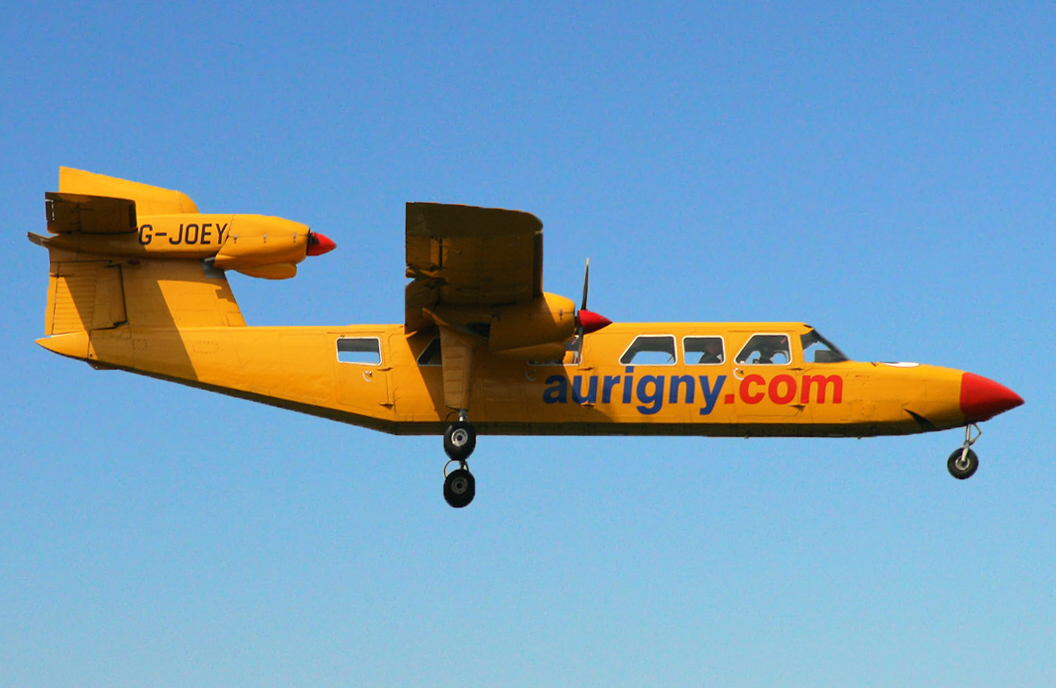
Channel Islanders had long called the Trislanders "Joey," and a local author's children's books about the little yellow plane made the name stick. Aurigny had been leasing one of the aircraft from Britten-Norman; when it bought the aircraft outright on November 27, 1981, it registered it G-JOEY and later painted a face on the nose. On this day in Guernsey records that the scarlet paint arrived in 1988 for the BBC's Comic Relief appeal, with the eyes and smile following soon after.
G-JOEY's last regular flight ran on Sunday, June 28, 2015, from Southampton (SOU) to Alderney and on to Guernsey, arriving at 19:40, ten minutes behind schedule, with David Rice flying. It had served Guernsey for almost 40 years, 34 of them with Aurigny.
The aircraft stayed. The Guernsey Press watched it leave Aurigny's hangar on April 10, 2018 on the back of a trailer, wings in the morning and fuselage in the afternoon, down Le Val des Terres and along the seafront to Oatlands, where it was reassembled inside a newly built play barn and suspended from a steel structure engineered to hold it. Oatlands Village dates the opening of Oaty and Joey's, which it still calls the aircraft's home, to January 2019.
Featured image: Aurigny Air Services Trislander G-FTSE at Southampton.
Featured image: Aurigny Air Services Britten-Norman Trislander G-FTSE at Southampton on March 21, 2012. Photo: NMOS332/CC BY-SA 2.0



.webp)