Riyadh Air Firms Up 34 Widebody Jets at Farnborough, Splitting the Order Between Boeing and Airbus


.webp)
FARNBOROUGH – Riyadh Air (RX) used the opening day of the Farnborough International Airshow to firm up two widebody commitments with Airbus and Boeing, extending a build-out that has moved fast for a carrier that only began flying passengers in June.
The Boeing order
Riyadh Air is exercising options for 28 more 787 Dreamliners, drawn from its March 2023 order, converting 20 of those aircraft to the larger 787-10, a variant the carrier had not previously placed orders for. The deal also discloses 11 previously unidentified Dreamliner purchases. Once the remaining 17 aircraft are finalized, Riyadh Air's firm 787 count will reach 67.
Tony Douglas, CEO of Riyadh Air, tied the expansion to the carrier's route ambitions, saying the addition of the 787-10 strengthens its ability to handle growing passenger and cargo demand while supporting network flexibility. Stephanie Pope, president and CEO of Boeing Commercial Airplanes, said the variant will complement Riyadh Air's fleet as the airline builds out its long-haul network.
The Airbus order
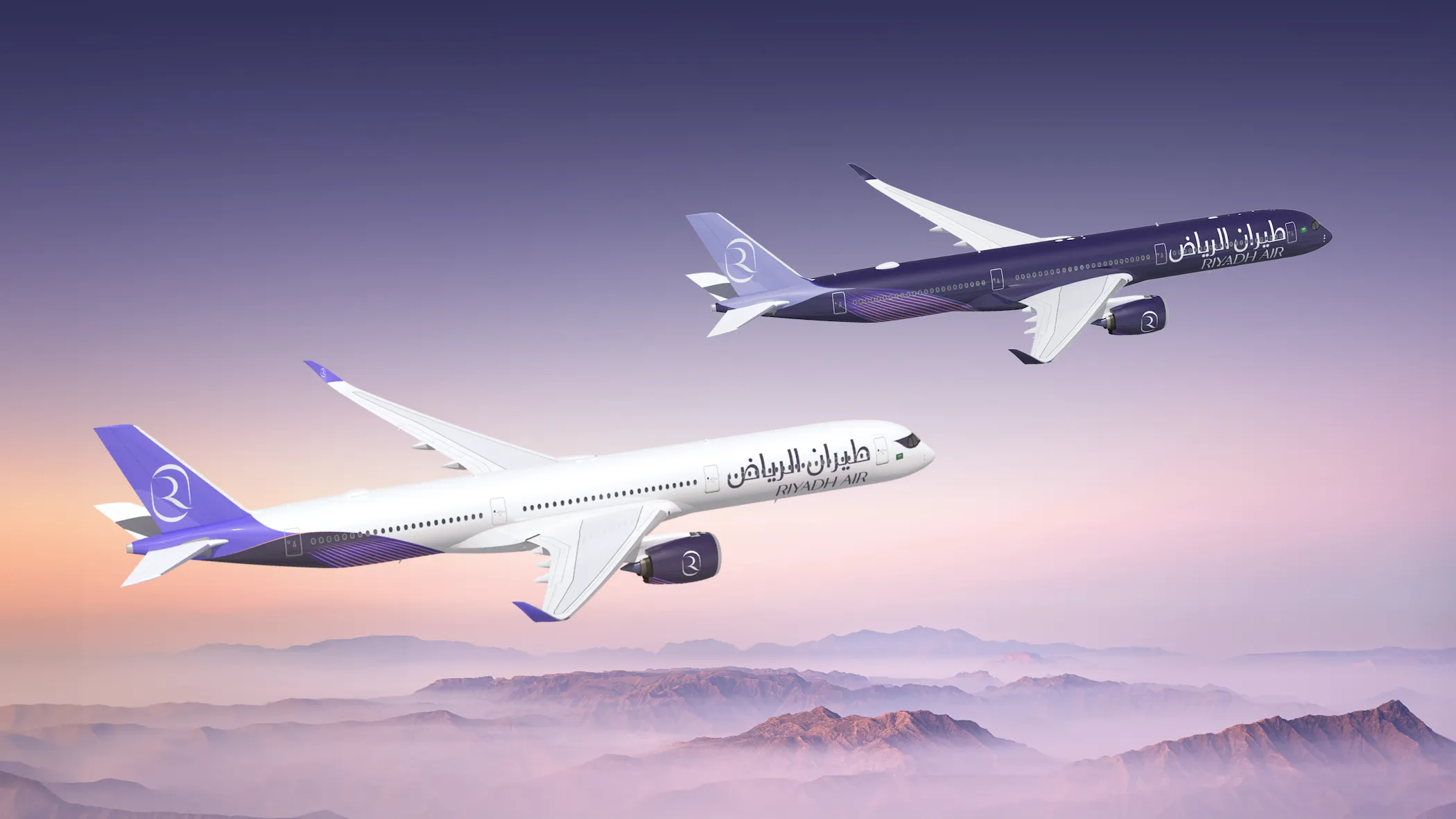
Separately, Riyadh Air firmed up six additional A350-1000s, raising its total firm commitment for the type to 31 aircraft under the original agreement for up to 50, announced at the 2025 Paris Air Show. Riyadh Air will be the first Saudi Arabian carrier to fly the type.
A fast build-out from a standing start
Riyadh Air, wholly owned by Saudi Arabia's Public Investment Fund, began full commercial operations in June 2026 with a Boeing 787-9 flight to London Heathrow (LHR). At the time of the Boeing announcement, the carrier had taken delivery of six 787-9s and served six destinations from its base at King Khalid International Airport (RUH) in Riyadh.
Trade reporting ahead of Farnborough indicated the in-service fleet would grow to eight aircraft and 22 destinations by March 2027. Set against that, the roughly 180-aircraft ceiling sometimes cited for Riyadh Air's total prospective order, firm plus options across the Boeing 787, Airbus A350-1000 and A321neo, is a long-term target rather than a near-term delivery schedule.
The carrier's order book also includes 60 Airbus A321neo-family aircraft ordered in 2024 for short- and medium-haul domestic and regional flying. Riyadh Air has said fleet commonality between the 787-9 and 787-10, including shared flight-deck systems, maintenance procedures and pilot training, factored into keeping the widebody fleet within a single Boeing family rather than diversifying further.
Growth thesis meets a difficult year for regional traffic
The announcement made today at Farnborough lands at an unusual moment for Middle East aviation economics, where long-run fleet plans and current traffic data are pointing in different directions.
IATA's original 2026 outlook had the Middle East reaching 240 million passengers this year, representing 6.1% growth, ahead of the 4.9% global average, and projected the region to lead the world in airline profitability, with US$46.9 bn in net profit. Boeing's newly released 2026 Commercial Market Outlook keeps its 20-year view largely unchanged from last year: about 43,600 aircraft deliveries through 2045, including roughly 7,700 widebodies, with the Middle East and Africa together representing about 10% of deliveries. A separate Boeing regional forecast issued in late 2025 projected the Middle East fleet more than doubling by 2044, with close to 1,400 new widebody jets needed, the largest widebody share of any region.
That structural case has been complicated by the regional conflict that began earlier this year. IATA cut its full-year 2026 global traffic growth forecast to about 2.1%, down from an earlier 4.9% projection, citing the war's effect on fuel prices and Gulf hub operations, and now projects Middle East passenger traffic will contract by roughly 11.4% for the year.
Monthly data has shown the scale of the disruption directly: April international demand for Middle East carriers fell enough to drag global revenue passenger kilometers down 3.4% even as the rest of the world grew, and IATA's March release showed international traffic for Middle East carriers down nearly 61% year-on-year, with global demand up 8% once the region was excluded. Airbus trimmed its own 20-year global delivery forecast by about 1% this month, also citing the conflict alongside trade tensions.
Widebody lead times run several years, meaning an order placed now targets fleet needs in the back half of the decade and beyond, not current-quarter demand. That gap softens the tension between this year's traffic data and the manufacturers' long-run forecasts, but it does not erase it.
Where this fits industry-wide
Riyadh Air's build-out mirrors a wider pattern of Gulf carriers locking in widebody capacity at this stage of the cycle. Boeing has said it enters 2026 with an industry-wide undersupply of close to 2,000 aircraft, with the widebody shortfall expected to persist into the early 2030s, a backdrop that gives early-firming customers leverage in the delivery queue.
For Airbus, the deal adds to an already large A350 franchise: as of the end of June 2026, the A350 family had accumulated 1,595 firm orders from 68 customers worldwide, among the strongest widebody order books in the industry.
Between the two announcements, Riyadh Air firmed up 34 widebody aircraft in a single day, 28 Boeing 787s and six Airbus A350-1000s, while leaving further options on both programs open for future conversion. The moves track the airline's stated 2030 network target and the manufacturers' own long-run Middle East forecasts. They also arrive in the middle of the sharpest regional traffic contraction IATA has recorded in years, a reminder that this is a wager on the Vision 2030 growth trajectory rather than on the state of the market today.
Featured image: Airways



.avif)